 Topics
50 Years Later: South America’s Operation Condor and Contemporary Transnational Repression
Francesca Lessa—
Transnational repression constitutes a “global threat to national sovereignty, security, and human rights,” according to a 2025 report from Freedom House. The term transnational repression describes the tactics that governments employ to persecute political opponents who are living in exile. States have adopted various strategies in this regard; they range from propaganda campaigns, surveillance, the infiltration of agents within exile groups, the confiscation of personal property, and the withdrawal of consular assistance and citizenship to violent practices such as abduction, enforced disappearance, murder, torture, and the persecution and/or arrest of exiles’ families and friends. Freedom House tracked 1,219 episodes of transnational repression perpetrated by 48 governments in 103 countries between 2014 and 2024; it determined that the top five “offending” countries of the last decade were China, Turkey, Tajikistan, Russia, and Egypt. The report also highlighted the key role of cooperation between governments in facilitating transnational repression, with 780 incidents across Eastern Europe, Central and Southeast Asia, and the Middle East and North Africa involving interstate collusion.
A “truly global wave of autocratization” is currently unfolding, according to the Varieties of Democracy (V-Dem) project, which reveals that 72 percent of the world’s population (5.8 billion people) now live in autocracies. This proliferation is particularly concerning for dissidents fleeing from one autocracy and living in exile in another, with cooperation on repression more common between countries under this type of regime.
Despite heightened global attention to transnational repression in recent years, the phenomenon has a long history. The persecution and assassination of anti-Fascist Italians abroad by the Mussolini regime in the 1920s and 1930s, including the 1937 murders of Carlo and Nello Rosselli in Paris, were early systematic acts of transnational repression. The high-profile 1940 assassination of Leon Trotsky in Mexico City, ordered by Stalin, demonstrated that such pursuit was not limited by regional or continental boundaries.
Reflecting on a historical case of transnational repression for which justice has been achieved is crucial in the face of mounting challenges to democracy and human rights.
Fifty years ago, between November 25 and December 1, 1975, military intelligence officials from Argentina, Bolivia, Chile, Paraguay, and Uruguay gathered in Santiago, Chile, invited by Colonel Manuel Contreras, head of the country’s Directorate of National Intelligence (DINA). At that meeting, attendees formally established what they called Sistema Cóndor (Operation Condor)—a secret network that would allow the officials to collaborate more efficiently in the harassment of political opponents living in exile across South America and beyond. This system of intergovernmental cooperation on transnational repression would expand to include Brazil in 1976 and Peru and Ecuador in 1978.
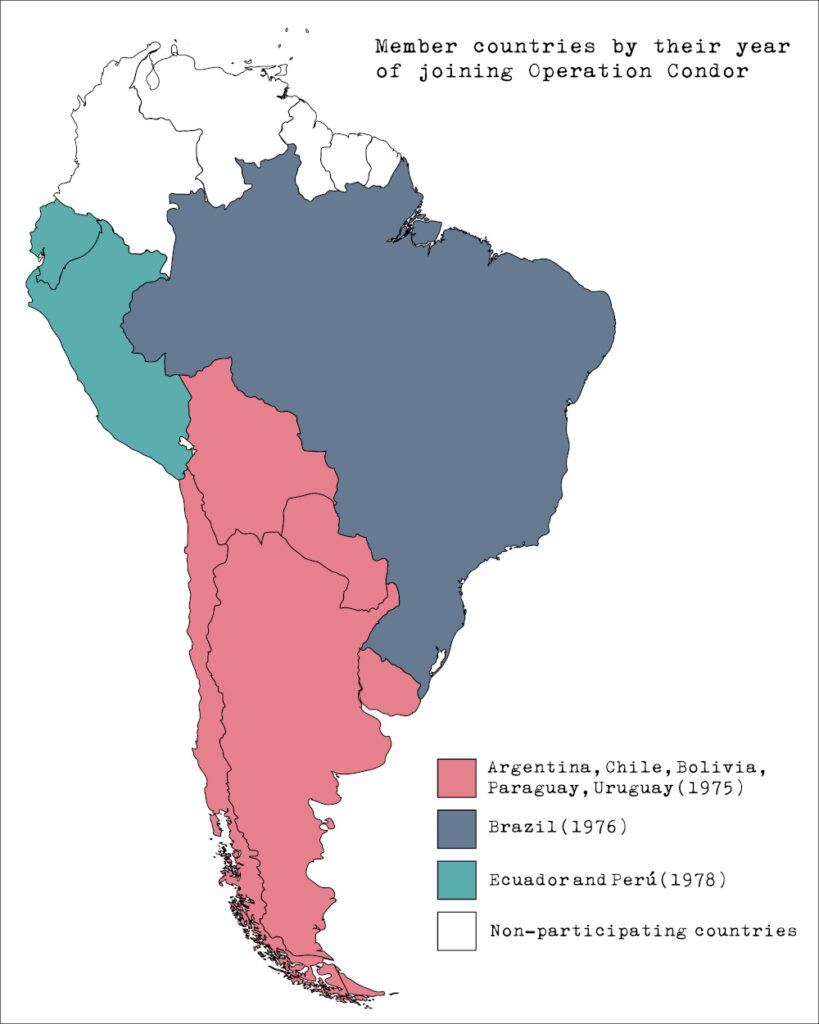
Building on years of ad hoc and bilateral collaborative practices in targeting exiled dissidents, dating back at least to 1969, these South American regimes set up a sophisticated, institutionalized, and ambitious system founded on three pillars.
The first pillar, a secret communications system dubbed Condortel, enabled Condor member states to quickly exchange intelligence on sought targets and joint operations.
The second, an operative axis known as Condoreje, included a forward command and operating office in Buenos Aires from which intelligence was processed and abduction operations were planned and executed. It was not a coincidence that this office was stationed in the Argentine capital. Thousands of people who had fled the persecution of the dictatorships installed in Paraguay, Brazil, Bolivia, Uruguay, and Chile had been living there since the late 1960s, thanks to Argentina’s long-standing tradition of welcoming refugees.
The third pillar, a basic computerized data bank located in Santiago, collated copies of intelligence cards and files from participating countries to centralize information on sought targets across the region.
Closely aligned yet beyond the purview of Operation Condor lay another nefarious initiative designed to target dissidents living outside of member countries. The top-secret Teseo unit, composed of agents from Argentina, Chile, and Uruguay (Brazil, Bolivia, and Paraguay chose not to participate), was a specialized team whose mission was to eliminate targets farther afield. After receiving training in Buenos Aires in late 1976, the unit was dispatched to Europe. Fortunately, intelligence leaks eventually forced all of Teseo’s operations to be aborted.
There are no official lists of Condor’s victims. However, through my research I have confirmed that there were at least 805 victims of transnational repression in South America between August 1969 and February 1981. The victims had diverse backgrounds: 40 percent were political and social activists; 36 percent were members of revolutionary armed groups; 13 percent had no affiliation; and 5 percent had official refugee status. While victims hailed from seven of the South American countries that participated in Operation Condor, three groups stand out: Uruguayans account for approximately half of the victims (48 percent), followed by Argentines (23 percent), and Chileans (14 percent). Furthermore, although victims were pursued in thirteen countries (Argentina, Bolivia, Brazil, Chile, Costa Rica, Paraguay, Peru, Uruguay, France, Spain, Italy, Portugal, and the United States), almost 70 percent of Condor operations took place in Argentina.
The crimes of Operation Condor were long shrouded in impunity and silence. Fifty years later, however, unprecedented progress has been achieved in revealing the truth about the horrors of transnational repression in South America and holding some of those responsible to account.
Justice seekers, including survivors, victims’ relatives, human rights lawyers, activists, journalists, and others have played keys role in unveiling these unspeakable crimes. I tracked fifty criminal cases that, since the late 1970s, specifically investigated Condor’s atrocities. These trials have taken place in Argentina, Brazil, Chile, France, Italy, Paraguay, Peru, Uruguay, and the United States. A first instance sentence (this is the initial decision made by the lowest court level after hearing a case; it can be challenged or appealed before higher courts) has been dictated in thirty-six cases, including thirteen in Argentina, eight in Uruguay, and seven in Chile. There are eight trials in progress—seven in Uruguay and one in Italy; three cases have been closed due to the defendants’ death; and four remain under preliminary investigation. Over 100 defendants have been convicted, including former presidents and foreign ministers such as the Uruguayan Juan María Bordaberry and Juan Carlos Blanco; high-ranking military officers such as Colonel Contreras; members of the diplomatic force, such as Paraguayan consul Francisco Ortiz Téllez; and intelligence officers, including the Argentine Eduardo Ruffo and Miguel Angel Furci.
These proceedings are significant for three reasons. First, these criminal lawsuits are probing the cases of 461 victims of South America’s transnational repression between 1969 and 1981. Second, they have exposed the secret inner workings of this system, contributing to truth, justice, and the construction of collective memory through the crucial testimonies of survivors, their relatives, and key experts—testimony that aided the work of judges and prosecutors. Third, the verdict in the Argentine Condor Trial (2013–16) determined that Operation Condor amounted to a transnational joint criminal enterprise (asociación ilícita) that used states’ resources to amplify member countries’ repressive policies and expand them to a regional scale. As such, Condor committed human rights violations beyond borders in a systematic and coordinated manner.
As transnational repression continues to threaten sovereignty, democracy, and human rights in the twenty-first century, the successful accountability efforts for Condor’s atrocities stand as a stark warning to governments and countries planning to engage in such practices. None is outside the reach of the law.
Francesca Lessa is associate professor in International Relations of the Americas at University College London and coordinator and principal researcher of Plancondor.org. The Condor Trials received the 2023 Juan E. Méndez Book Award for Human Rights in Latin America. Lessa lives in London, UK.
The post 50 Years Later: South America’s Operation Condor and Contemporary Transnational Repression appeared first on Yale University Press.
Aregentina,Chile,democracy,dictatorship,Francesca Lessa,international relations,latin america,Operation Condor,opression,Paraguay,South America,transnational repression,Uruguay
Source link yalebooks.yale.edu
