
Voters Don't Trust Trump or RFK Jr. to Handle a Public Health Crisis
A hantavirus outbreak has intensified scrutiny of the Trump administration’s capacity to respond to infectious disease threats, particularly due to President Donald Trump’s deep cuts to the Centers for Disease Control and Prevention and his decision to withdraw from the World Health Organization, as well as the controversial leadership of Health Secretary Robert F. Kennedy Jr.
A new Data for Progress survey gauged awareness of the hantavirus outbreak and assessed public trust in Trump and RFK Jr. to handle a public health crisis.
The survey finds that most voters have at least some awareness of the hantavirus outbreak. More than 1 in 4 (28%) say they have heard “a lot” about the spread of the virus, while a majority (53%) have heard “a little.” Just 19% say they’ve heard nothing at all.
Additional Data for Progress polling finds that the hantavirus outbreak was one of the top-cited news stories that voters had seen, read, or heard about last week.
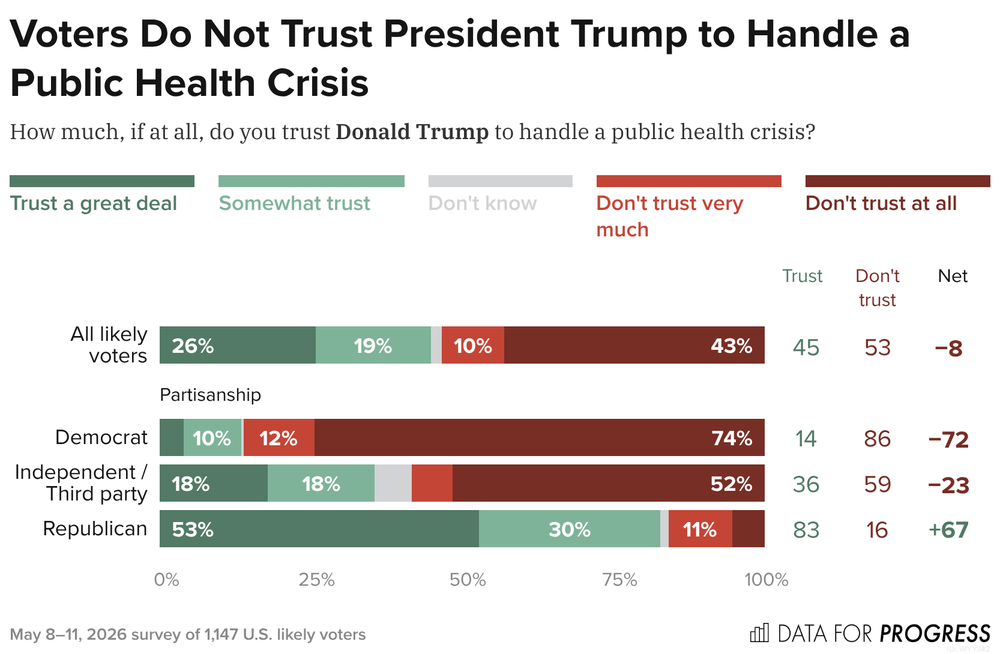
While the hantavirus outbreak is not likely to lead to a pandemic, the survey shows that voters broadly do not trust President Trump to manage public health responses. A majority of voters (53%), including 59% of Independents, say they don’t trust Trump to handle a public health crisis — leaving him 8 points underwater overall.
Voters are similarly skeptical of Kennedy. A majority of voters (51%), including 58% of Independents, say they don’t trust Kennedy to handle a public health crisis, while 42% do trust him.
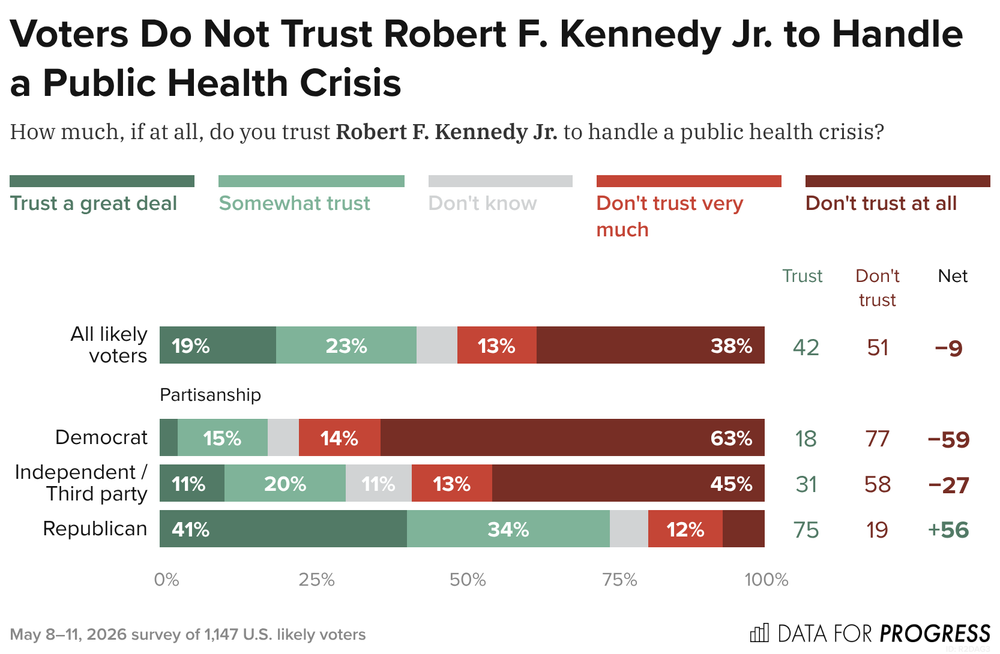
Broadly, these findings indicate that most Americans do not trust the two officials most responsible for managing a federal public health response.
Survey Methodology
From May 8 to 11, 2026, Data for Progress conducted a survey of 1,147 U.S. likely voters nationally using web panel respondents. The sample was weighted to be representative of likely voters by age, gender, education, race, geography, and recalled presidential vote. The survey was conducted in English. The margin of error associated with the sample size is ±3 percentage points. Results for subgroups of the sample are subject to increased margins of error. Partisanship reflected in tabulations is based on self-identified party affiliation, not partisan registration. For more information, please visit dataforprogress.org/our-methodology.
Source link www.dataforprogress.org
