 Topics
What Ancient Athens Can Teach Us About Fixing Democracy
In ancient Athens, frustrations and disillusionment with the political system may have helped fuel the rise of ostracism—a system that allowed citizens to exile powerful figures seen as threats to the political order. Through the story of Themistocles, this essay explores how early democracy responded to public dissatisfaction and asks whether modern systems can adapt in similarly meaningful ways, without the upheaval that often accompanied change in the past.
In the run-up to the 2024 UK General Election, a UK university poll found that half of young people surveyed were dissatisfied with how democracy works in the UK.1 In a 2025 UK Youth Poll (for those aged 16-29) the results again underlined young people’s concern about the state of democracy.2 This is not a UK-specific response, but one that can be paralleled in many countries for a variety of political, economic and historical reasons. The nuance of these polls is that most young people are not calling for the rejection of democracy in favor of more authoritarian styles of government, but instead for a better system of democracy that can deliver meaningful change.
Such findings might make us reflect on the origins of democracy as a political system in ancient Athens and what we might take from it as we seek to reinvigorate and perhaps reinvent democracy in the 21st century. Modern politicians often talk about the link between ancient and modern democracy as if it was an unbroken chain. But the reality is of course that, for most of the centuries between the invention of democracy in ancient Athens and its wide adoption in the modern world, the reaction to ancient Athens’s political system has been one of revulsion. Even in the debates of the Founding Fathers in America, as the Papers of James Madison show, ancient Athenian democracy was rejected as an exemplar for the new American Constitution, with participants famously stating that “had every Athenian been a Socrates, every Athenian assembly would still have been a mob.”3
I have recently written a biography of the Athenian statesman Themistocles, who grew up in the early heady days of Athenian democracy. He was just sixteen when Athens threw off its final version of tyrannical rule and instead embraced a system of “equality before the law,” that would evolve into a system of “demokratia” or “people-power” over the following thirty years. Themistocles came from a family of no special consequence, and it was in large part only because of this changing political system around him that he was able to break through to play a major political role, serving, for example, as its chief magistrate just after his thirtieth birthday.
But what Themistocles also bore witness to was an extraordinary surge in aggressive political people-power in the decade after he was chief magistrate. During the 480s BCE, the sources bear witness to the first use of “ostracism” in ancient Athens. We are not sure whether the process of ostracism had been in existence since the adoption of the new “equality before the law” system twenty-plus years previously, whether it had technically existed even before that, or whether it was brought into being for the first time during the 480s. But what’s clear is that the Athenians embraced it in the 480s with gusto. Of all the attested ostracisms during the whole of the fifth century BCE, half of them take place in the 480s. This was the ostracism decade.
But what was it? Ostracism involved the Athenian people coming together to agree first on whether an ostracism vote was required. If they agreed that it was, then everyone wrote the name of one person they would like to see ostracized from Athenian politics. They wrote that name on small, discarded fragments of pottery known in ancient Greek as “ostraca” (from where the name of the vote—and our word ostracism—comes). The votes were counted and the person with the most votes was banished from Athens for 10 years. It’s not difficult to see why the Founding Fathers characterized ancient Athenian democracy as mob rule.
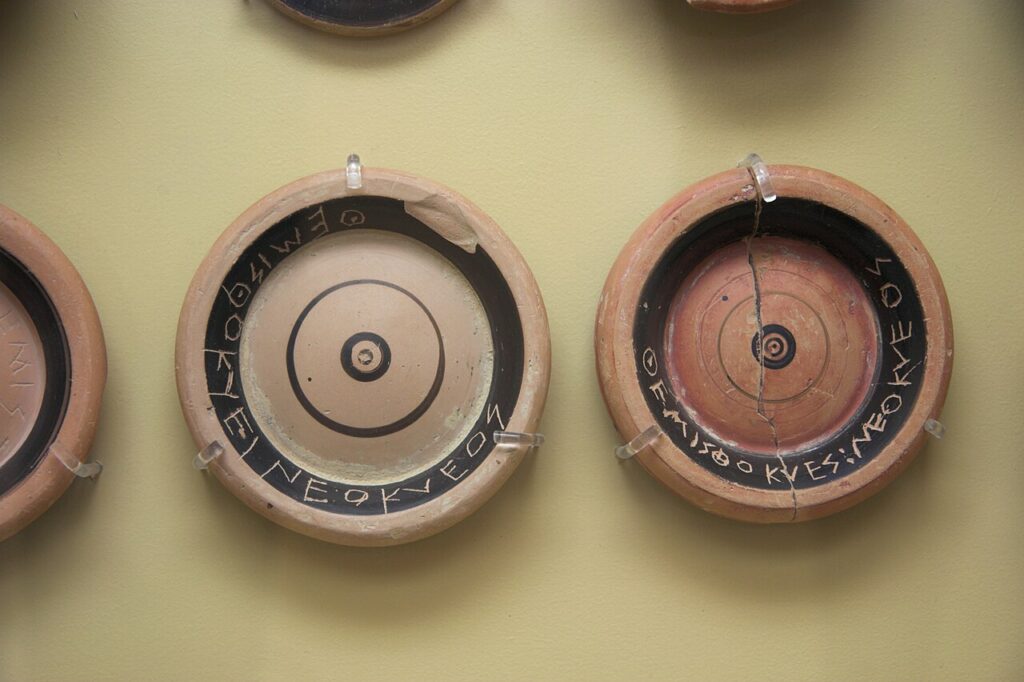
Early votes in the 480s show the Athenians were mostly focused on expelling those still associated with tyranny; later in the decade, they targeted those associated with Athens’s enemies. But increasingly, this mechanism was used to expel those who had simply become too big for their boots —those who thought the system was about them rather than them serving the system, and its people. Themistocles’ name during the 480s appears on these ostraca —but never quite in high enough number to top the table.
What prompted the sudden take-up of ostracism in the 480s in Athens? Some point to the increased need for security occasioned by the Persian invasion at Marathon in 490 BCE and the incursions of other local foes. No doubt there is something in that. But perhaps it was also occasioned by a feeling of disillusionment in the system—now more than two decades old—and its ability to deliver on its promises and effect real change. Ostracism has been categorized as enabling the Athenian political system to let off steam, to signal its key grievances and problems; and at a basic level, to let everyone just formally say what—or rather whom—was bothering them.
Many have suggested that ostracism could provide an inspiration for the kind of reforms the young would like to see today, as a lightning rod to reinvigorate democracy and enable it to deliver on its ideals. For ancient Athens, the turbulent politics of the 480s, combined with Athens’ survival—and indeed glorious victories—against the Persians in 480 and 479 BCE, set in train the emergence of a triumphal era of democracy across the following decades. Perhaps something similar might result again today, hopefully from political reform alone, without the need for major conflict alongside it. But politicians beware: Themistocles did eventually top the ostracism vote and found himself out of Athens in the late 470s BCE. He, for all his experience of Athenian politics, had seemingly forgotten the single most important rule of Athenian politics: it’s not about you, it’s about the people.
- Royal Holloway, University of London, “Survey Finds That Nearly Half of Young People Are Unhappy with UK Democracy,” July 4, 2024, https://www.royalholloway.ac.uk/about-us/news/survey-finds-that-nearly-half-of-young-people-are-unhappy-with-uk-democracy/
 ︎
︎ - “University of Glasgow – Glasgow Social Sciences Hub – Young People Believe in Democracy but Fear for Its Future, Finds Survey of Youth.” n.d. https://www.gla.ac.uk/explore/glasgowsocialscienceshub/resources/all/headline_1167843_en.html. ︎
- “The Avalon Project : Federalist No 55.” n.d. https://avalon.law.yale.edu/18th_century/fed55.asp. ︎
Michael Scott is professor of classics and ancient history and pro-vice-chancellor for international affairs at the University of Warwick, UK. He is the author of several books, including Delphi: A History of the Center of the Ancient World; Ancient Worlds: A Global History of Antiquity; and X Marks the Spot: An Adventurous History of Archaeology, as well as writer and presenter of multiple documentaries for BBC, ITV, National Geographic, and SBS. www.michaelscottweb.com
The post What Ancient Athens Can Teach Us About Fixing Democracy appeared first on Yale University Press.
Ancient Athens,Athens,democracy,Founding Fathers,Greece,James Madison,ostraca,ostracism,Persian,Persian invasion,political,socrates,Themistocles,world history
Source link yalebooks.yale.edu
