Democrats Lead the Generic Ballot by 8 Points as Midterms Approach
The 2026 midterm elections are less than six months away. While primary elections are underway, the mid-decade congressional redistricting war started by Texas is ongoing, and Republicans are now looking to come out ahead after the Supreme Court’s decision in Louisiana v. Callais. The decision undermined the Voting Rights Act’s role in redistricting, which had been used since its passage in 1965 to boost minority representation in more racially segregated areas of the country. In Southern states like Tennessee, Alabama, Louisiana, and Mississippi, several Black Democratic incumbents in the U.S. House of Representatives are at risk of being gerrymandered out of their majority-Black districts. Once all is said and done, Republicans could shift 14 House seats to the right.
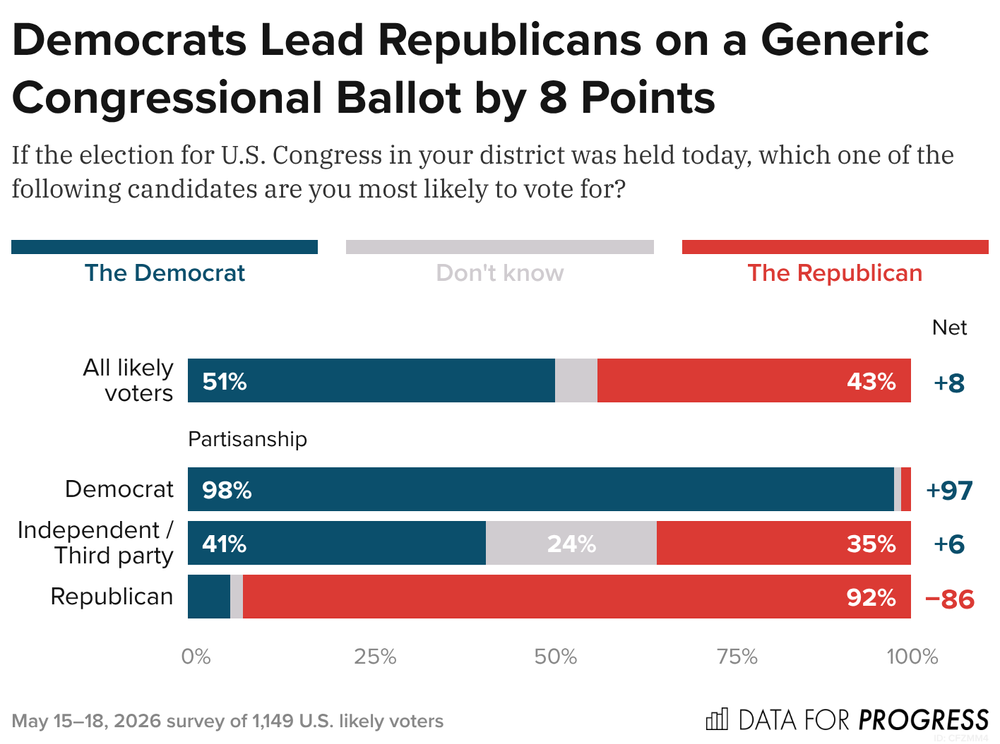
While the U.S. House map looks increasingly friendly to Republicans’ chances of retaining control of Congress, a new Data for Progress survey finds Democrats leading Republicans on a generic congressional ballot by 8 points. Independents prefer a Democrat over a Republican for Congress by a +6-point margin, while around 1 in 4 (24%) remain undecided.
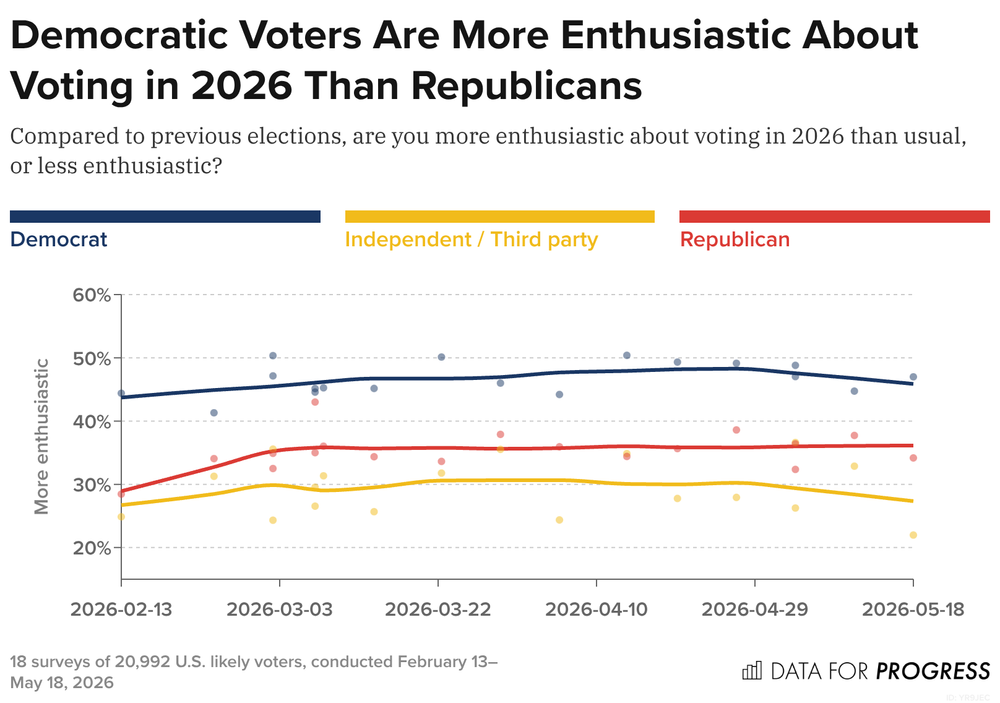
Democratic voters are also expressing higher enthusiasm than Republicans and Independents toward voting in the 2026 elections — 47% of Democrats say they are more enthusiastic about voting in 2026 than usual, compared with 34% of Republicans.
As has been the case for the last decade in politics, a core energizing factor for Democrats is opposition to President Donald Trump. Ninety-two percent of Democrats say they disapprove of how the president is handling his job.
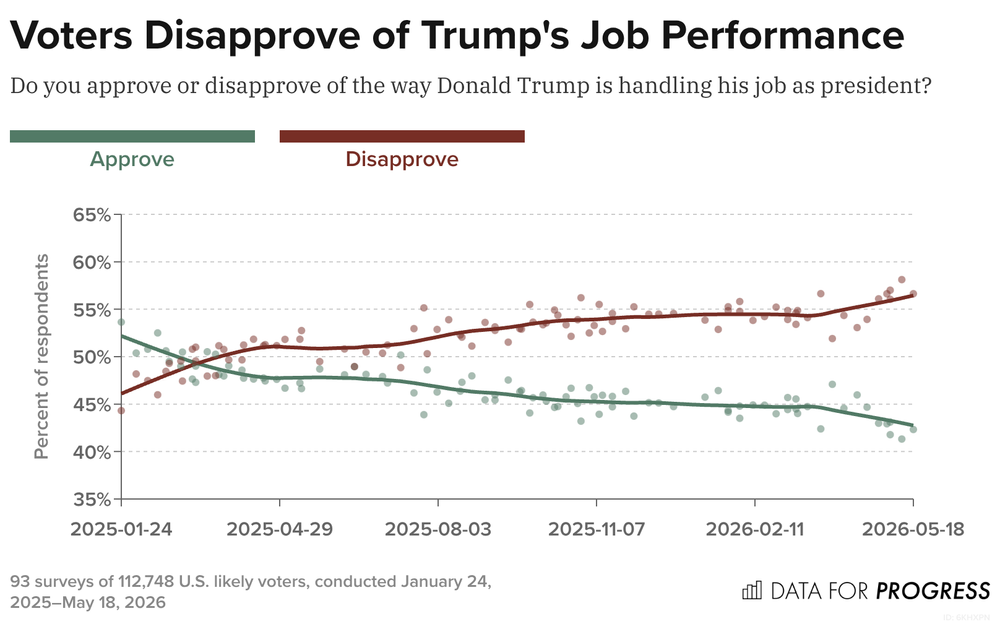
But it’s not only Democrats — likely voters overall are increasingly souring on the president. A majority of voters, including 56% of Independents, now say they disapprove of Trump’s job performance, a -13-point margin.
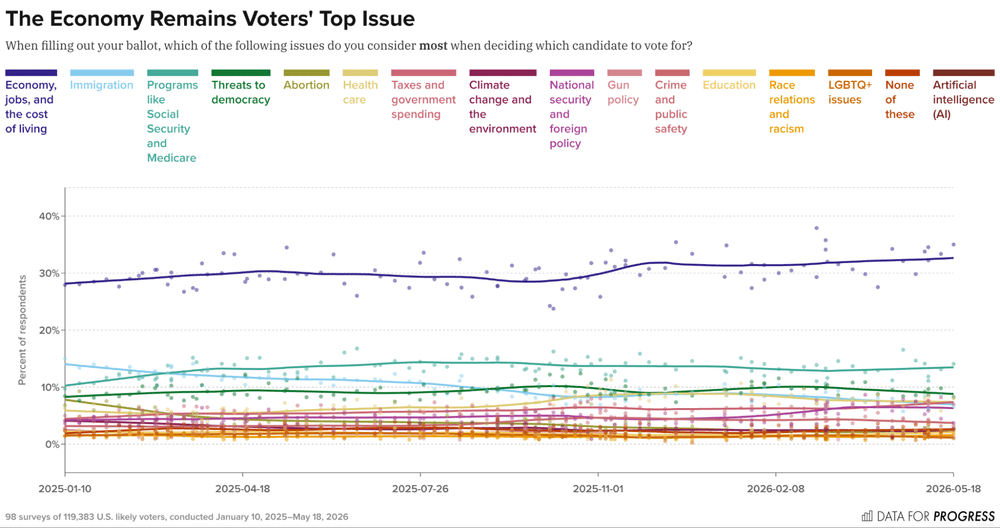
When it comes to the issue voters consider most when deciding which candidate to vote for, the economy, jobs, and inflation still reigns supreme. About 1 in 3 voters choose the economy as their top issue (35%), followed by Social Security and Medicare (14%), threats to democracy (8%), and healthcare (8%).
Notably, immigration has declined in importance, with 15% selecting it as a top issue in January 2025 and only 7% doing so today.
Voters trust the Democratic Party over the Republican Party on 12 of 15 issues tested. Democrats hold their largest advantages on LGBTQ+ issues (+25-point margin), climate change and the environment (+19), race relations and racism (+17), abortion (+15), and healthcare (+15). Majorities also trust Democrats over Republicans on programs like Social Security and Medicare (+14) and education (+11).
Additionally, voters trust Democrats over Republicans on inflation by an +8-point margin, on jobs and the economy by 3 points, and on taxes and government spending by 2 points.
Republicans hold a narrow edge on immigration: 48% trust the Republican Party to handle immigration, compared with 43% who trust the Democratic Party.
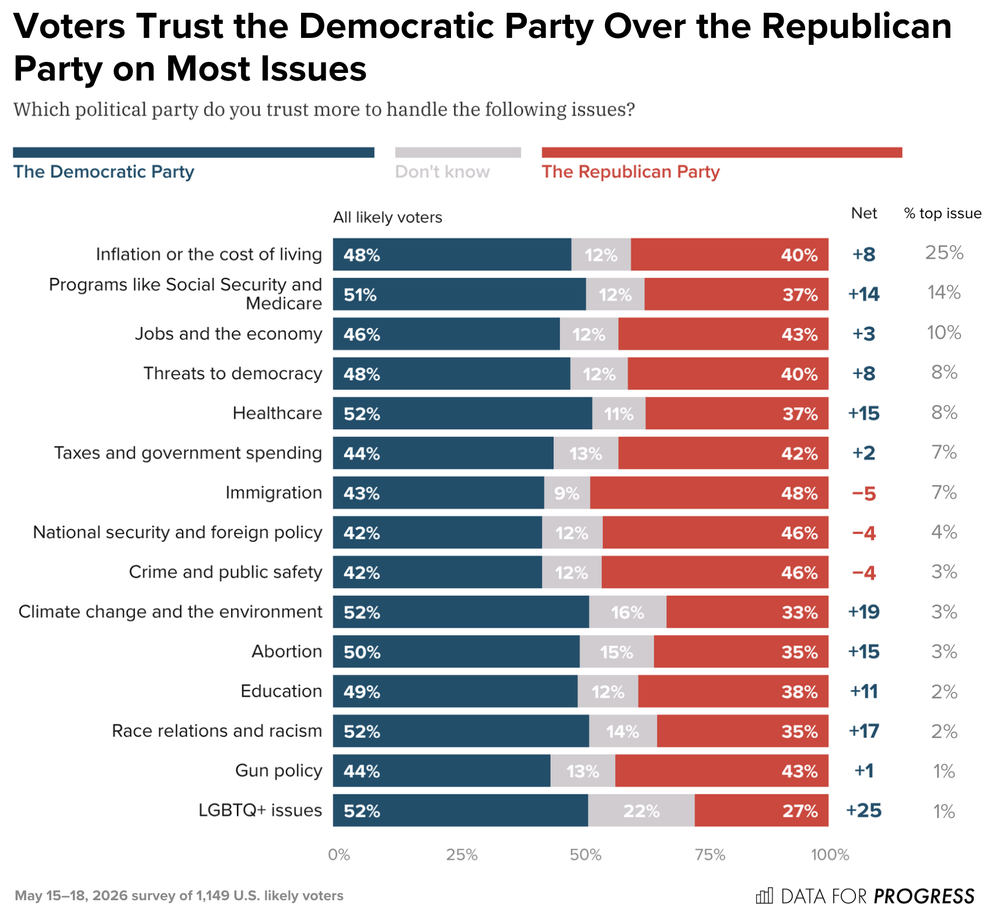
Broadly, these findings indicate that, despite an uncertain redistricting landscape, Democrats enter the 2026 midterm cycle with meaningful advantages in public opinion. Voters prefer a Democrat over a Republican for Congress by 8 points, trust Democrats more on 12 of 15 issues — including their top issue, the economy and jobs — and are growing increasingly unfavorable toward Donald Trump.
Survey Methodology
From May 15 to 18, 2026, Data for Progress conducted a survey of 1,149 U.S. likely voters nationally using web panel respondents. The sample was weighted to be representative of likely voters by age, gender, education, race, geography, and recalled presidential vote. The survey was conducted in English. The margin of error associated with the sample size is ±3 percentage points. Results for subgroups of the sample are subject to increased margins of error. Partisanship reflected in tabulations is based on self-identified party affiliation, not partisan registration. For more information, please visit dataforprogress.org/our-methodology.
Source link www.dataforprogress.org
