A Hard Civics Lesson: MN Students Learned to Stand Up to ICE

This is the final article in a four-part series on how Operation Metro Surge impacted students, educators, and administrators in Minnesota after ICE agents swarmed the state and caused chaos and confusion there for weeks. Go here for Part 1, Part 2, and Part 3.
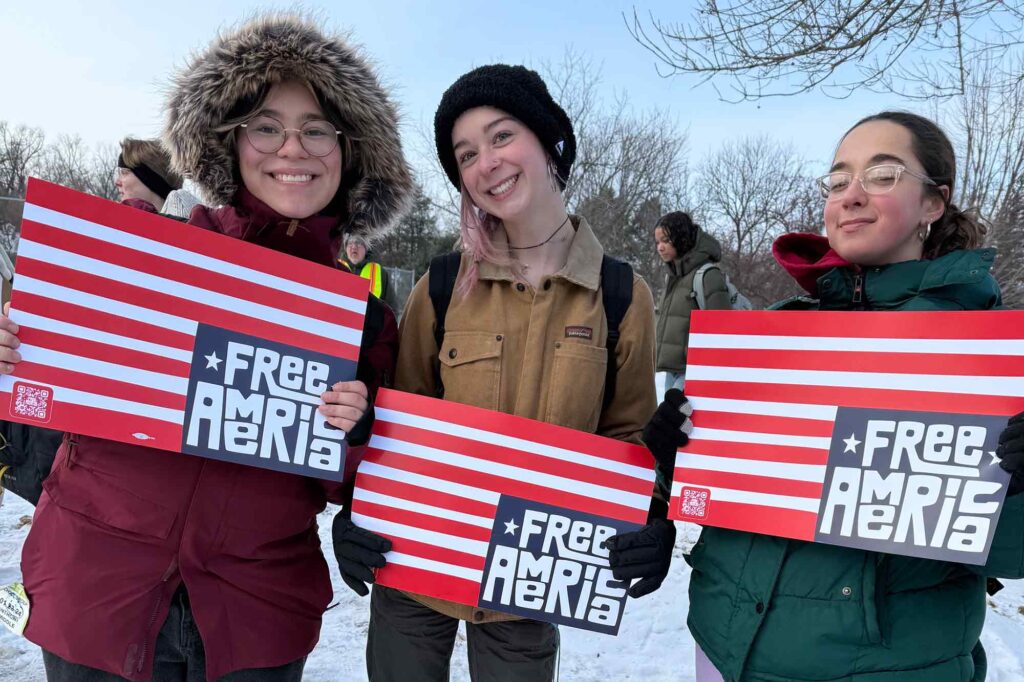
Throughout the country, American middle and high schoolers are taught about how the government works, how societies function, and about the importance and impact of civic engagement. During Operation Metro Surge, students in Minnesota experienced what it’s like to witness history playing out firsthand.
They not only saw what happens when a government tries to impose its will on a community with a show of force, but also how regular people can fight back. And, for many of them, it was more than a theoretical lesson.
Like Leo J., a student at Southwest High School who asked to remain anonymous.
On January 23, three days after his school staged a walkout, he put on five layers of clothing, a thumb splint, and ski goggles to join more than 50,000 people at an “ICE Out” protest in Minneapolis.
That rally, he said, instilled a sense of hope and pride in him that he had never experienced before.
“The roaring and ongoing ‘ICE Out’ chants still echo in my head… The incredible protest art, statues, puppets, elaborate clothing decorations, and music remains vivid in my mind,” he recalled.
And, thanks to social media, people across the world got to be a part of the anti-ICE resistance.
This is something fellow Southwest High School student Clara Henry experienced. One of her friends brought a creative Adventure Time sign to the walkout. It read “Protest Time: Melt The ICE!” and garnered over 54,000 likes when it was featured on the Women’s March Instagram.
“They put that as the cover photo,” said Henry, a sophomore. “That was a really cool sign.”

Photo credit: Courtesy of Clara Henry
She ended up documenting the protest through a story for her school newspaper, The Navigator. Henry also published an article to ensure her peers knew their rights if they were approached by ICE. Still, she said, living in a fear-ridden city due to the actions of federal agents made her feel powerless.
And that was the point, explained Katie Lingras, an associate professor at the University of Minnesota in the Department of Psychiatry & Behavioral Sciences.
“[Operation Metro Surge] was having the intended effect to create fear and to show who has the ‘power,’ and that rightfully worries all of the community,” said Lingras.
However, instead of yielding to that power, the residents in the Twin Cities, including many students, responded by marching in protests.
This kind of civic engagement is important, Lingras noted.
“I think that can be a really powerful way to re-empower kids when they’re feeling like this is completely outta my control. There’s so much uncertainty,” she said. “One thing I know I can do is have the autonomy to help.”
Henry, for example, felt it was important to carry on the work of past advocacy groups.
“It feels like we’re advocating for and fighting for the exact same things that generations before us have been fighting for, and it seems like we should have progressed past that point by now,” she said.
Henry and her peers set an example for others throughout the country.
During the first few months of 2026, thousands of high school students across America participated in student-organized walkouts.
In some cases, these were well received, like in Oklahoma City, OK, where state Sen. Michael Brooks (D) invited them to the state capitol.
Meanwhile, in Austin, TX, a series of anti-ICE walkouts involving students angered Gov. Greg Abbott (R), to the point that the Texas Education Agency threatened to investigate and sanction Austin school districts that allowed their students to participate. As a result, students who participate in school protests throughout Austin going forward must be marked “absent.”
While none of these kids was old enough to vote in the election that resulted in the immigration crackdown, they nevertheless chose to exercise their First Amendment right to stand up for those bearing its consequences.
As the school year in Minneapolis drew to a close, the majority of students who participated in online learning for the sake of their safety returned to their schools. However, the trauma from Operation Metro Surge still lingers.
When talking to school administrators, teachers, and students across Minneapolis, our investigation found some common threads.
On the one hand, there was a shared loss of community that resulted from some students being forced to stay at home. It was similar to what many of them had already experienced during the COVID-19 pandemic.
On the other hand, it also fostered a different kind of community. It allowed those who weren’t targeted by ICE to be there for their friends and neighbors and to show them that they weren’t alone. This forged a new sense of togetherness in the city and, in particular, its schools.
During Operation Metro Surge, teachers and students became allies in a cause that went beyond education, although the children certainly learned a lesson in civic engagement and what it looks like when a government tries to exert control.
From teachers who helped organize food drives for families in hiding, the superintendent who worked tirelessly to limit the harm ICE was causing in her district, and students who wrote articles for their school newspapers or protested in the freezing cold, more than anything, what we found is a story of a community persevering.
And while the often brutal government crackdown clearly left students and educators traumatized, the resistance to it, which forced ICE to retreat, also gave them hope.
This story was written by a member of our Mentor Apprentice Program (MAP). It gives aspiring journalists an opportunity to hone their craft while covering national and international news under the tutelage of seasoned reporters and editors. You can learn more about the MAP and how you can support our efforts to safeguard the future of journalism here.
A Hard Civics Lesson: MN Students Learned to Stand Up to ICE originally appeared on WhoWhatWhy
[ad_2]
Source link whowhatwhy.org
The final article in a series about Operation Metro Surge discusses its impact on Minnesota students and educators as they witnessed federal law enforcement’s show of force. Students like Leo J. and Clara Henry actively participated in protests, which fostered a sense of hope and civic engagement. Despite the trauma and fear induced by ICE actions, students supported one another, forming new community bonds. Educators also became allies, providing resources and organizing food drives. This experience served as a powerful civics lesson, showing students how to stand against oppression while highlighting the enduring spirit of their community.
