
A Meeting of Minds
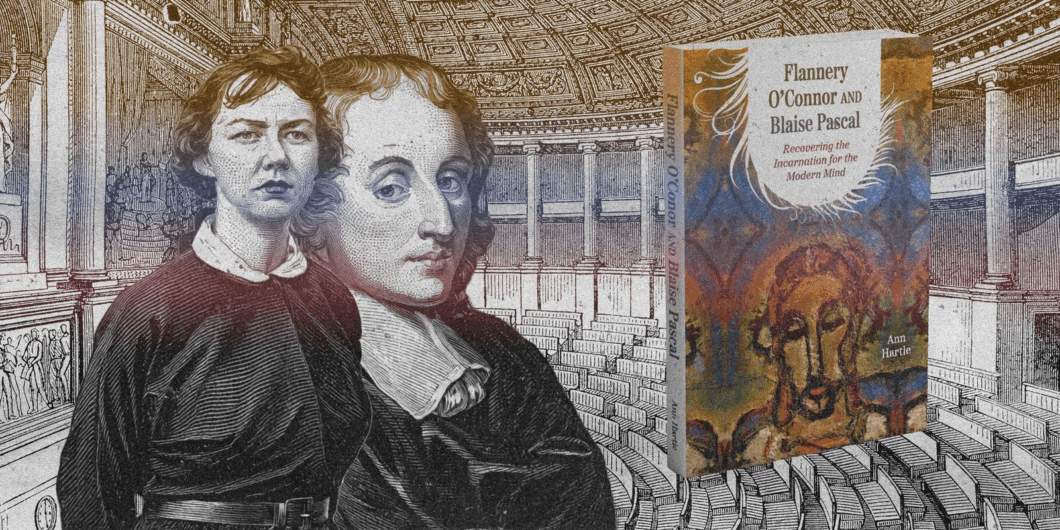
It is a great tribute to the profundity of Flannery O’Connor’s work that it continues to generate quality secondary literature many years after her death. Lately the conversation has taken a philosophical turn, exploring O’Connor’s relevance to some of the defining debates within modern philosophy. An excellent example of this kind of work is Ann Hartle’s Flannery O’Connor and Blaise Pascal: Recovering the Incarnation for the Modern Mind.
It is an insightful and at times brilliant analysis of the Southern writer’s work. Hartle makes a valuable contribution to O’Connor scholarship by placing her in conversation with important modern thinkers, while also employing the tools of literary theory. Hartle explains, “I approach O’Connor’s work from a philosophical perspective rather than the perspective of a literary critic.” She later reiterates she is “illuminating the meaning of her stories for the searching mind of modern man.”
An Intriguing Mode of Analysis
Hartle’s aim is to show that O’Connor provides a coherent and forceful response to “modernity,” though she understands modernity in a very particular way. She is interested in the loss of the “prophetic vision,” beginning in the Enlightenment, that once provided the lens through which we understand “the nature of man, his fall from innocence, and the divine source of goodness.”
To explain the currents of modernity, Hartle employs an interesting methodology. She builds her dialectic around two “teams,” one enthusiastic about modernity and the other far more critical. In one corner, O’Connor is allied with Blaise Pascal, the seventeenth-century French mathematician, scientist, and Christian apologist, who shares many of O’Connor’s concerns about modernity’s deep deficiencies. In the other, we find the sixteenth-century French philosopher and essayist, Michel de Montaigne, and the twentieth-century psychologist Carl Jung. Hartle argues that modernity, especially as it has emerged in the twentieth century and beyond, is a calamity for faith, reason, and morals, and that Pascal is the quintessential anti-modernist to unfold O’Connor’s philosophy.
One may wonder why Hartle has assembled these historical figures as she has, especially Montaigne. Hartle anticipates our question as she explains,
Jung captures the essence of modern consciousness, the form of human consciousness which emerged in early modern philosophy, especially in the Essays of the sixteenth-century philosopher Michel de Montaigne. … To understand how O’Connor responds to the modern condition, I turn to one of Montaigne’s most trenchant critics: the seventeenth-century philosopher Blaise Pascal.
Though Montaigne contributed to the philosophical evolution that draws man into himself and consequently away from God, at the same time, Montaigne was himself a Catholic and humanist whose essays speak to O’Connor’s insistence on self-knowledge. Useful for productive self-reflection, for example, is his essay, “To Philosophize Is to Know How to Die.” In addition, Montaigne was influenced by St. Augustine of Hippo, especially his Confessions. Though it is true that Pascal was troubled by certain of Montaigne’s essays, Pascal was also, in turn, influenced by Montaigne, all the while leveling sharp criticism at the essayist. Pascal was also critical of René Descartes, who is a more important early figure in the emergence of modernism; indeed, Descartes is the central figure. Hartle, though, is focused on Montaigne rather than Descartes; a reasonable strategy given her scholarly expertise in Montaigne.
Hartle sees in Montaigne at least two characteristics that make him a more significant influence in philosophical modernity than some realize. His essay medium brings philosophy down to the street level, accessible to a broad audience. Secondly, Montaigne turns our attention away from the divine to the solely human. Indeed, and as Hartle notes, Pascal found Montaigne’s apparent indifference to meaningful religion deeply disturbing, though, ironically, Montaigne as a foil brought out the best in Pascal, not only in substance but also in the aphoristic style that characterizes the Pensées. Nonetheless, Pascal’s criticism is at times surprisingly harsh, almost visceral. In #63, he wrote, “Montaigne’s faults are great. … He suggests an indifference about salvation, without fear and without repentance. As his book was not written with a religious purpose, he was not bound to mention religion; but it is always our duty not to turn men from it.” Montaigne’s conception of death is “pagan,” even “cowardly and effeminate.”
To some, this dialectic may feel curious or ad hoc, but Hartle rightly notes that both Jung and Pascal were of interest to O’Connor. As is typical for O’Connor, however, her comments about both are brief and incidental to other discussions. She once told Alfred Corn, a young man struggling with faith at Emory University, that Pascal might be useful for him, and she remarked to another correspondent that “Jung is probably just as dangerous as Freud.” Yet O’Connor seems to acknowledge the psychologist as an important figure worthy of attention: “Jung has something to offer religion, but is at the same time very dangerous for it.” O’Connor wrote to Fr. James McCown (and this confirms Hartle’s strategy): “You ought to get hold of [Jung’s writing] just to see what you have to combat in the modern mind.”
Pascal and the “Spiritualization of the Incarnation”
Pascal’s inclusion merits some explanation, also. His response to the Cartesian tradition does not draw upon the classical or scholastic tradition, though O’Connor is deeply indebted to those traditions. Pascal endorsed man’s ability and obligation to reason; at the same time, and unlike certain other figures of the Enlightenment, Pascal famously insisted that reason has its limit, as he asserts, “The heart has its reasons which reason knows not.” He argues that a truly rational approach requires balancing reason with divine mystery. “Truly, thou art a God who hidest thyself, O God of Israel, the Savior,” writes Isaiah (45:15, KJV). Pascal’s understanding of mystery would undoubtedly have been gratifying to O’Connor, as would Pascal’s call to humility. Man is “lost” in a “remote corner of nature.” His existence is dwarfed by the universe.
Hartle explains that her thesis is based on the “spiritualization” of the incarnation. This is an interesting phrase, but its meaning is not self-evident, and some explanation is in order: she seems to consider that the central Christian event has been redefined and given a “purely human meaning.” Other phrases that might be used include “secularizing the incarnation” or “desacralizing the incarnation.” Joseph Ratzinger (Pope Benedict XVI) warned against “naturalism,” which reduces the spiritual and supernatural to merely human experience. Hartle’s phrase underscores the way in which those she criticizes have “abstracted” the spiritual into meaninglessness.
Descartes purports to reason his way to his own existence and then to the existence of God; Pascal, by contrast, laments how easily man is led astray given how easily reason and the senses mislead.
So, for example, she explains that “Jung denies the historical reality of the incarnation, turning it into a mere idea or symbol which is essential for psychological health.” Accordingly, “Pascal and O’Connor see their task as the recovery of the historical embodied reality of the incarnation for the modern mind from the distortions of this spiritualization.” This misappropriation of the central Christian event is re-purposed in the interest of “modern man’s attempt at self-creation and self-redemption.” This brings to mind O’Connor’s well-known response to American novelist Mary McCarthy (The Group, The Groves of Academe), who, at a dinner party, insisted that the Eucharist is just a symbol. O’Connor answered, “Well, if it’s just a symbol, to hell with it!”
Fiction and the Fight
Hartle analyzes several of O’Connor’s stories and demonstrates how they are meaningful responses to modernity: her novel Wise Blood, her short story “Good Country People,” O’Connor’s second novel The Violent Bear It Away, and her oft-anthologized “A Good Man Is Hard to Find.” All of these analyses are revealing; Hartle’s combination of Pascal and “A Good Man Is Hard to Find” is the most straightforward and compelling. In this story, the character of the Misfit seems to speak for O’Connor: He is uncompromising when it comes to the appropriate response to Divine revelation. Indeed, he asserts that Jesus has “thrown everything off balance.”
If He did what He said, then it’s nothing for you to do but throw away everything and follow Him, and if He didn’t, then it’s nothing for you to do but enjoy the few minutes you got left the best way you can—by killing somebody or burning down his house or doing some other meanness to him.
For Pascal, the choices are no less stark as he anticipates the equivocation that is a hallmark of the modern age. He asserts,
There are only three sorts of people: those who have found God and serve him; those who are busy seeking him and have not found him; those who live without either seeking or finding him. The first are reasonable and happy, the last are foolish and unhappy, those in the middle are unhappy and reasonable.
Like the Misfit, Pascal offers no middle ground. He asserts that there is “an absolute distinction between those who strive with all their might to learn and those who live without troubling themselves or thinking about it.” This “supernatural torpor” is a “monstrous thing.”
He has little sympathy with individuals who are not brutally honest with themselves: “I can only approve of those who seek with groans.” Several of O’Connor’s characters are given the opportunity to respond to grace with nothing less than brutal honesty.
Descartes purports to reason his way to his own existence and then to the existence of God; Pascal, by contrast, laments how easily man is led astray, given how easily reason and the senses mislead. Even more, reason and sense experience may be set in turmoil by the passions. He explains, “These two sources of truth, reason and the senses … deceive each other in turn.” The faculties “rival each other in falsehood and deception.”
Hartle further demonstrates that for all of her supposed reasoning powers, Hulga, in “Good Country People,” is trapped in self-deception precisely by her misdirected reason, made even worse by her doctorate in philosophy. Her faulty senses, moreover, mislead her to the ill-starred encounter with Manley Pointer, taking her to a point of no return when the hunter becomes the hunted. Hartle observes that Hulga’s “wooden leg captures the condition of the personality in the grip of modern consciousness: something essential is missing.” Hulga is, to borrow Pascal’s phrase, “without grace,” though the reader is left suspecting that her abject humiliation may expose her divine intervention. That possibility is suggested by the mirage of Pointer as O’Connor describes Hulga watching the faux Bible salesman, carrying away her wooden leg. She writes, “When she turned her churning face toward the opening, she saw his blue figure struggling successfully over the green speckled lake.” The illusion of his ability to “walk on water” suggests that, evil though he is, Pointer is the unwitting instrument of God’s grace to drive a wedge into Hulga’s puerile arrogance. As Pascal notes, “Evil is easy, and has infinite forms.”
Hartle’s book requires a devoted read from even a well-informed reader—but it is worth the effort. Her innovative strategy is successful, yielding deep insights into O’Connor’s concerns and work. Perhaps subheadings within the chapters might be useful, and some might appreciate an early chapter on Pascal, Montaigne, and Jung to set the stage for their employment in Hartle’s project.
Quibbles aside, Hartle’s analysis of O’Connor rings true in virtually every instance; her observations are neither sharp nor flat, and her combination of Pascal and O’Connor is a pleasing harmony—the contrast with Montaigne and Jung appropriately cacophonous. Flannery O’Connor and Blaise Pascal: Recovering the Incarnation for the Modern Mind is not to be missed. Like O’Connor and Pascal, moreover, the only consequential response to the misdirection of modernity is, at the end of the day, religious conversion. Such conversion, though framed by reason, is a matter of the heart.
Source link lawliberty.org
