
AI in an Age of Humanity
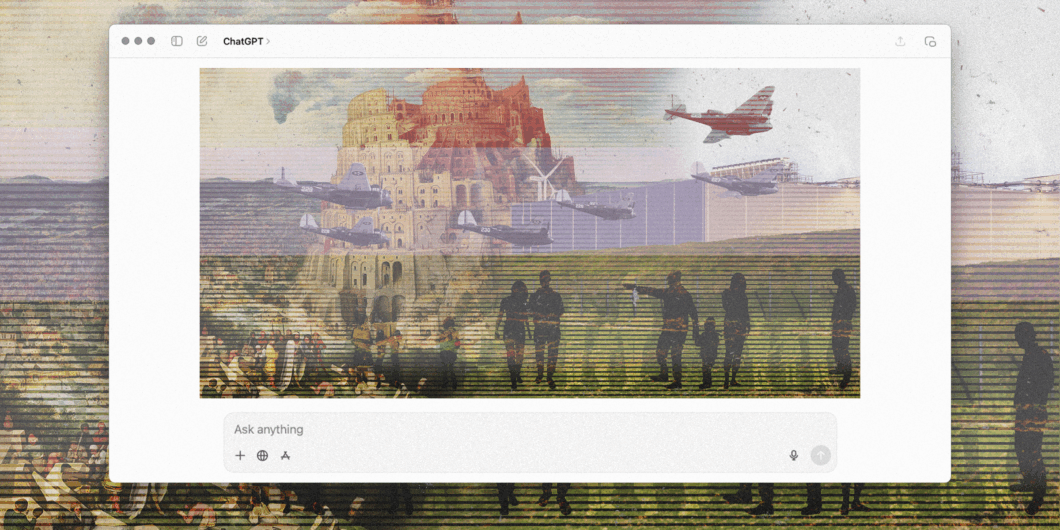
The beloved 1985 young-adult novel Ender’s Game tells the story of a boy who thinks he’s practicing to kill aliens using a computer simulation, until he discovers he was remotely piloting real ships and hitting real targets all along. Now, in 2026, there is a program at the US Department of Defense called Ender’s Foundry. It exists to simulate battle scenarios and “ensure we stay ahead of AI-enabled adversaries.”
The irony of this is probably not lost on Sam Altman, CEO of OpenAI (the company behind ChatGPT). Until very recently, OpenAI’s official corporate policy banned the use of its programs for military purposes. The Pentagon ignored that ban even when it was in place, and at the end of February, OpenAI faced facts publicly by announcing it had signed a contract with the US government right as President Trump was launching Operation Epic Fury against Iran. Life comes at you fast.
“We think the US military absolutely needs strong AI models to support their mission especially in the face of growing threats from potential adversaries who are increasingly integrating AI technologies into their systems,” said OpenAI in a statement. Like Ender, Altman has had the nasty surprise of realizing that the dreamlike virtual world of digital tech and the ugly real world of physical violence are one and the same. Unlike Ender, Altman was never purposefully deceived about this by anyone—except, perhaps, by himself, if he thought the tools he was building could be reserved for lovelier projects than war.
There’s a popular meme format in which Anakin Skywalker from the Star Wars prequels makes a proposal to his lover Padmé, and her smile fades as it dawns on her that he doesn’t mean it quite the way she thought. In the age of machine learning, there’s now a video version in which Anakin suggests building more data centers because “AI needs it.” “To cure cancer, right?” asks Padmé. At which point the camera pulls back to reveal her breasts, enlarged to the point of absurdity by whatever prompt the creator fed the machine. So far, the use cases of this software have not always been as humanitarian as its advocates might have hoped.
The media theorist Marshall McLuhan became famous in certain circles for insisting that the real importance of a new tool can be found in “the medium—that is, all the side-effects, all the unintended patterns and changes.” He was anticipated in this by Plato, who had Socrates hint in a story that “the person who produces an instrument of technology is not the same as the person who can judge whether it helps or harms those who use it.” If that’s true, then we would expect to find the architects of AI struggling to predict and control the ends it will be made to serve.
The most extreme predictions all tend to posit that this machinery will so utterly transform the basic parameters of life on earth as to render old verities about human nature obsolete.
They are. Altman isn’t the only one who’s having to adjust his mental model of what’s possible and desirable. When OpenAI made its deal with the military, it supplanted its competitor Anthropic, whose CEO Dario Amodei had just reversed course in the opposite direction. Amodei concluded from his time on the inside that it was impossible for his coders to guarantee protection against government misuse. This is the same judgment OpenAI had reached before conveniently revising it when the opportunity arose.
That made some people skeptical when Altman swore up and down that he was drawing bright red lines at letting machines spy on Americans or decide where and when to drop bombs. Mass domestic surveillance and fully autonomous weaponry, guided by software that can aim and trigger strikes on its own, were among the things OpenAI prohibited in clauses that were supposed to make its contract with the government different from Anthropic’s. On the other hand, since the government skirted similar prohibitions before signing the deal, it’s hard to see why they would hold good afterward.
Meanwhile, Altman told his employees in March that “you do not get to make operational decisions” about how the US chooses its targets. Constitutionally speaking, that has to be true, but it also doesn’t inspire confidence. Human officials don’t always act with a maximum of circumspection in the fog of war to begin with, and new technologies have a way of slipping their traces under such conditions. It’s hard to imagine that OpenAI’s “security stack” (the set of protocols employed by designers to set boundaries on what can and can’t be done) will be enough to keep things from getting out of hand.
One of the things that keeps happening in tech is that idealistic professions of humanitarian ethics melt away upon contact with the hot imperatives of capital and power. “From ethics, enlightened self-interest, and the commonweal, our governance will emerge,” wrote the cyberlibertarian poet John Perry Barlow, addressing the supposedly outmoded nation-states of the world from Davos in his 1996 Declaration of the Independence of Cyberspace. Many early adopters of the Internet hailed it as a borderless dreamscape where blissed-out peaceniks and garage tinkerers would collaborate at light speed in a joyous riot of innovation and bonhomie. The innovation materialized. The bonhomie, less so.
Google, which ranks today among the world’s leaders in AI, adopted the slogan “Don’t Be Evil” in the early 2000s, then steadily walked it back after former employees filed a lawsuit alleging that some of its practices were, in fact, evil. The idealists of the tech industry seem prone to this kind of disappointment—the kind borne of the discovery that even very wondrous machines don’t make people more altruistic or less venal. There are more than a few indications that the pioneers of AI are going through a similar period of disillusionment.
For one thing, they keep walking back their plans in a way that suggests they are growing more suspicious not just of government entities, but also of private consumers. Amodei says his new model, Claude Mythos, could be used to hack so easily through most cybersecurity protocols that he’s not releasing it to the public. OpenAI is pulling commercial products, too. The company scuppered its video generator, Sora, prompting The Walt Disney Company to back out of a $1 billion licensing deal based on the app. Shortly afterward, Altman’s team put another set of plans on hold indefinitely when they decided not to let loose a chatbot that was free to talk dirty with users.
Maybe Altman was irked that Sora, which was billed as a revolution in the visual arts, has instead become known as a bottomless font of short-form clips in which cats play the violin or llamas act out Regency period pieces while wearing ducks as hats. Maybe he wants to distinguish himself from Elon Musk, whose competing video App (“Grok Imagine”) seems noteworthy chiefly for its ability to make even pancakes look lewd. Maybe it was just that Sora reportedly cost OpenAI $1 million a day.
On the other hand, tech companies have often been happy to front loss leaders if they can plausibly market them as prescient investments in a revolutionary future. What seems to have happened is that Altman’s projected image of that future has become grittier and less fantastical. One OpenAI spokesperson said the point of nixing Sora was to help shift corporate focus away from content creation and toward building things “that will help people solve real-world, physical tasks.” Tasks like bombing Iran.
All this suggests that the age of AI will be more pockmarked by human vices and reliant on human virtues than either the polyannas or the doomers have tended to imagine. Various optimists have foretold an imminent day in which the bots will put an end to manual labor, teach our children about world literature, usher in one-world government, or become God. Meanwhile, the pessimists, for their part, have warned of hideous disaster scenarios in which the bots … put an end to manual labor, teach our children about world literature, usher in one-world government, or become God.
Whether you think that sounds like a return to paradise or a speed run toward the end times, the most extreme predictions all tend to posit that this machinery will so utterly transform the basic parameters of life on earth as to render old verities about human nature obsolete. A lot of the drama comes from imagining a world without some or any of the constants that were once considered permanent hallmarks of our existence as a species: work, art, politics, and death.
Instead, it seems more reasonable to expect that the conditions of the fallen world and human nature will remain the same, except now with AI. This is a likelihood that the titans of tech, who have a habit of expecting to slip the ancestral bonds of humanity any day now, tend not to factor in. But it has major consequences.
One is that the value of AI for creative work probably has its limits. For the time being, at least, auto-generated art remains stubbornly anodyne, or at best intriguingly grotesque and bizarre. The aesthetic resources of this technology lend themselves less readily to heartbreaking works of staggering genius than to llamas with hats—or to duanju, China’s hugely popular “micro-dramas” (otherwise known as “vertical dramas,” because they are formatted to play on an upright smartphone).
Micro-dramas distill the canonical story arcs of daytime soap opera to their Platonic essence, stamping out the usual templates without bothering to fill in any unusual details specific to this particular iteration. The template is the content. It’s all cookie-cutter, no cookie: a feisty young heiress first resists, then succumbs to, the flirtations of a mysterious billionaire. Ninety seconds at a time of pure cliché. Perfect for a computer program whose chief parameter is the weighted average.
There are structural reasons why the quality of auto-generated storytelling might be headed for an inescapable asymptote. And there are serious psychological reasons why, even if a pile of code could burp out a perfectly crystalline sonnet, it would matter less than a rough-hewn one suffused with real human emotion.
In other words, there are some things humans can do, and should do, that even very advanced pattern recognition algorithms—which are what deep learning models basically are—can’t and shouldn’t. One is to make art. Another is to make moral decisions, like whom to kill in a war. There’s a pattern here, noted in 1988 by Austrian computer scientist Hans Moravec and summarized by the economist Carl Benedikt Frey in his book How Progress Ends: “Tasks that are simple for humans, such as hiking, are incredibly difficult for robots and AI systems, while activities that require extensive human reasoning, like playing chess at a grandmaster level, can be more easily executed by computers.”
This is known as Moravec’s Paradox, but there’s nothing all that surprising about it unless you start from the assumption that humans are just advanced biological algorithms, which would lead you to expect that our abilities could be replicated in code given enough processing power. This was essentially the view proposed by the founding father of modern computing, Alan Turing, which may help explain why his acolytes are perpetually surprised to find that it’s not true.
The technical literature on AI is now flooded with researchers making different versions of this discovery, over and over again, and there are X accounts mainly devoted to expressing shock each time
(usually in terms furnished for the author by an AI text generator). It should not have come as a surprise that a stochastic function for choosing the next most likely word is by nature incapable of becoming a great writer, or that a machine which lacks a sentient experience of reality has an incorrigible habit of making things up. But these are the sorts of things we now need studies to prove.
All of AI’s limitations, and all of its potential, are determined by the fact that it is derivative, not transcendent, of mankind’s magnificent and terrible capacities.
The problem, which goes to the heart of the AI industry, is one of confusion about what sets people apart from robots. “We don’t know if the models are conscious,” said Amodei to Ross Douthat on his podcast at The New York Times. “We are not even sure that we know what it would mean for a model to be conscious or whether a model can be conscious.” Maybe, he speculated, it has something to do with anxiety.
Actual AGI—the “advanced general intelligence” which would supposedly set AI on a par with humans if achieved—is notoriously elusive and hard to define. One new test suggested that current Large Reasoning Models can only achieve anything resembling competence within the predetermined regions (“domains”) covered by the training data that their designers select. “Take a moment to appreciate how strange this is,” write the study’s authors: “Human reasoning capacity is not bound by domain knowledge.” It is fluid, adaptable, and endlessly responsive to new facts. Another revelation.
The nineteenth-century philosopher Wilhelm von Humboldt, reflecting on our species’ unique faculty of speech, observed that human intelligence “makes infinite use of finite means.” That is something AI models, for all their feats, are simply not set up to do. You could almost say they make finite use of infinite means. The only limits on how much data they can take in are practical, not theoretical—it depends, for example, on the size of the servers and the time available, not on the principles behind the design. But all the training data, however much of it there is, has already been structured by the organizing attention of a human mind—compiled, recorded, and given form by living intelligence before the models sift through and recombine it. This they do at scales we could never achieve unassisted.
It’s amazing and exciting to have machines that can do this. But it basically amounts to unlocking the enormous potential that was latent in our existing knowledge from the start. Once that potential is exhausted, the machine is out of juice. We are that juice: our thoughts, our reasoning, our observations about the world. Start training a model on its own output, and it will dissolve into gibbering nonsense. It needs new input from a human source. It always will.
This is pretty much the only certainty about the future of AI. All of its limitations, and all of its potential, are determined by the fact that it is derivative, not transcendent, of mankind’s magnificent and terrible capacities. It can spot incipient tumors on an MRI scan that a human eye might miss, but probably not without the oversight of a trained oncologist to catch their hallucinations and make judgment calls about treatment. It can spin up fantasy graphics faster, sharper, and cheaper than anything we’ve ever seen in the age of CGI, but it will probably never write a really good screenplay. It is already honing our missile tracking systems and drone strike capacities—as well as those of our adversaries—but there is a good case to be made that letting it fire missiles on its own should in itself constitute a war crime.
Which is not to say it won’t happen. One of the human defects that remains firmly in place despite our material progress is pride. Not infrequently, this takes the form of imagining we can shuck the weight of our moral responsibilities or outsource the hard work of creativity by perfecting some system—be it political, religious, or technological—that accounts for all contingencies and takes away the terrible burden of freedom. Put simply, we like to think we can get something bigger than us to do the job of being human for us. But we’re it: the highest form of life on this planet, God help us. The buck stops with us.
We will navigate the coming years best, then, if we refrain from indulging either in moony claptrap about perpetual peace or in gloomy admissions of defeat in advance. “The person who produces an instrument of technology is not the same as the person who can judge whether it helps or harms those who use it,” and the people who built AI have shown themselves singularly ill-equipped to understand what it can and can’t do. Perhaps that’s because they tend not to understand what humans can and can’t do.
We can build marvelous inventions and soaring cathedrals, for example, but not end war or cheat death. This ancient counsel of humility is also, counterintuitively, the only thing that will preserve our agency going forward. Nothing will ever replace us, and prudence in human affairs has always been an odd balancing act between treating this fact as both bad and good news. The age of AI will be no different in that key respect. It will really be, as every age before it has been, an age of humanity. We are, for the foreseeable future, in charge.
Source link lawliberty.org
