BUYBACK BLOWOUT: FIRMS REPURCHASE $4.8T OF STOCK SINCE 2017 TRUMP-GOP TAX LAW
Huge Tax Cuts Used to Enrich Shareholders Rather Than Boost Pay or Investment
Overview
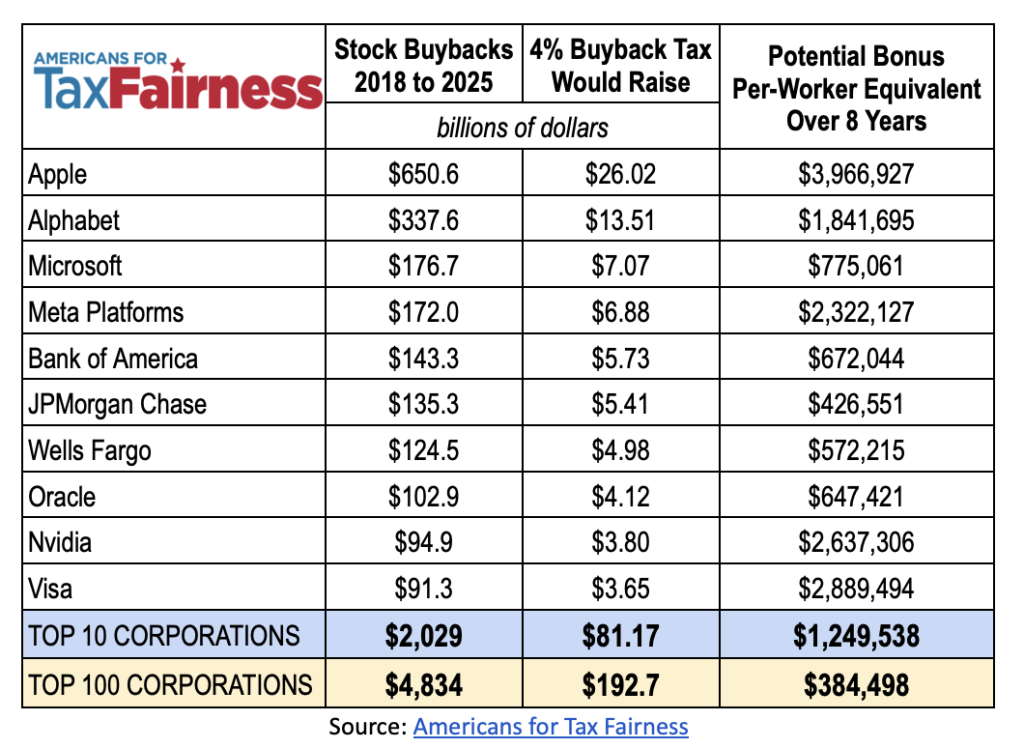
One hundred of America’s biggest corporations over the eight years since enactment of the 2017 Trump-GOP tax law have used their tax cuts to help repurchase $4.8 trillion of their own stock, according to a new analysis by Americans for Tax Fairness (ATF). Since 2017, stock buybacks have become a popular method by firms to further enrich shareholders, typically in lieu of boosting worker pay or investing in the business. If the Stock Buyback Accountability Act, a key legislative proposal to ensure the country receives some economic benefit from buybacks, had been in effect it would have potentially raised nearly $200 billion in revenue over those eight years from just those 100 firms. Of that group, just 10 mega-companies were responsible for over $2 trillion worth of repurchases.
“The huge tax cuts corporations received from the 2017 Trump-GOP tax law–which were supposed to be used to increase employee pay and business investment–have instead been wasted on trillions of dollars of stock buybacks,” said David Kass, ATF’s executive director. “Stock buybacks widen economic inequality by making already wealthy shareholders even richer. We need the Stock Buyback Accountability Act now more than ever.”
Background
Prior to 1982, stock buybacks were illegal because they were deemed to be a form of stock manipulation. But starting under President Reagan, corporations were allowed to start using profits to repurchase their own outstanding shares, thus increasing the value of stock remaining in investors’ hands. The resulting rise in stock price created by a buyback is not taxed unless the stock is sold. With the top 5% of households owning 70% of all stocks, that is a big benefit for wealthy investors, who prefer the unrealized income which comes from buybacks to the traditional corporate dividends that are paid out and taxed on an annual basis. Moreover, foreign investors are not taxed at all when they sell their stock at a profit, but are taxed on their dividend income.
Studies over several recent years have shown that stock buybacks are associated with income inequality, stalled innovation, lower productivity growth, and layoffs. Additionally, corporate executives are often rewarded financially through bonus and vested equity based on their corporation’s stock price rather than sustainable or durable growth indicators. This creates perverse incentive structures to juice the stock price through buybacks.
One of the most dramatic cases of stock buybacks having a negative impact on a company’s long term operations is that of Boeing, where between 2000 to 2020 $59.3 billion was spent on repurchasing the company’s own shares, diverting much needed money from manufacturing quality and safety. This shortsighted corner-cutting may have contributed to the tragic deaths of 364 people. The profits-over-safety ethos certainly tarnished Boeing’s once sterling brand as a reliable airplane builder and sent the company into near bankruptcy, requiring a taxpayer-funded bailout. Given the financial fallout of such disastrous corporate management, Boeing has ceased all stock buybacks as of 2021.
Policy Changes and Legislative Room for Improvement
With enactment of the Inflation Reduction Act, corporations conducting buybacks have been subject to a 1% tax starting in 2023. This was a good first step, with the Joint Committee on Taxation estimating this tax would generate $74 billion in new revenue over the next decade. But this rate has not been enough to curb stock buybacks and corporations have exploited the so-called “netting loophole” that allows them to dodge billions in potential taxes. In 2025, after the passage of Donald Trump’s second round of tax cuts, the S&P 500 corporations conducted a record $1 trillion of stock buybacks, almost double what they spent when Trump took office in 2017.

Source: Americans for Tax Fairness analysis of 10-K and S&P Global data
Leader Schumer (D-NY), Senator Wyden (D-OR), and Senator Warren (D-MA) have introduced the Stock Buyback Accountability Act, which would raise the stock buyback tax from 1% to 4% and close the netting loophole.

Source: Americans for Tax Fairness
Combined, the following top ten stock-buybacker corporations paid $380 billion in federal income taxes over the same eight-year span, but that means they paid five times more to private shareholders through stock buybacks than they paid in public taxes.
Analysis of Major Companies’ Stock Buybacks
APPLE
Apple is among the most valuable companies in the world, recently worth around $4 trillion. The tech titan bought back the most stock by far of the 100 companies studied, over $650 billion worth in the past eight years. If Apple had instead used that money to pay bonuses to its employees, every single worker could have received nearly $500,000 extra every year for each of those eight years, or a total of almost $4 million per worker. During this same period Apple paid just $59.5 billion in federal income tax, meaning this corporation paid their shareholders 11-times more than they paid in taxes
Apple has offshored nearly all of its production; its massive investments in China helped turn that country into an economic powerhouse and trading rival of the United States. Since the enactment of the 2017 Trump-GOP tax law, Apple’s top five corporate executives have been paid more than $1.3 billion.
ALPHABET
Alphabest was the second biggest share repurchaser, buying back $338 billion worth of its stock in the past eight years. During this same period Alphabet paid just $82.2 billion in federal income tax, meaning this corporation paid their shareholders 4-times more than they paid in taxes. It also was recently worth about $4 trillion, though despite this wealth the company recently cut 12,000 jobs.
Thanks in part to the 2025 Trump-GOP tax-and-spending law, Alphabet’s federal taxes fell by almost half from the year prior ($20.8 billion to $11.3 billion), despite their domestic profits increasing by a third. The biggest tax breaks and loopholes that Alphabet benefited from last year, according to the Institute for Taxation and Economic Policy include:
- $3.3 billion from depreciation deductions
- $3.9 billion from the Foreign Derived Intangible Income (FDII) deduction
- $2.1 billion from the research and development tax credit
- $2.6 billion from the stock option loophole.
Since the enactment of the 2017 Trump-GOP tax law, Alphabet’s top five corporate executives have been collectively paid nearly $1.6 billion.
MICROSOFT
Microsoft bought back nearly $176 billion of its stock in the last eight years. The software giant was recently worth over $3 trillion. During this same period Microsoft paid just $59.6 billion in federal income tax, meaning this corporation paid their shareholders triple what they paid in taxes.
In May 2025, Microsoft laid off 6,000 workers, or about 3% of its total workforce; then in July, 9,000 more. The company was one of several to receive a letter from U.S. Sen. Elizabeth Warren (D-MA) demanding an explanation for its layoffs in the wake of rising profits and tax cuts, estimated at $12.5 billion for 2025.
In 2023, Microsoft announced that the IRS, after a decade-long audit, was demanding almost $29 billion back taxes, penalties and interest. The agency asserted the company had dodged taxes through the use of a tax shelter in Puerto Rico.
Since the enactment of the 2017 Trump-GOP tax law, Microsoft top five corporate executives have been collectively paid over a billion dollars.
META PLATFORMS
Meta (owner of Facebook and Instagram) repurchased $172 billion of its own shares in the past eight years. It was recently worth over $1.7 trillion. In 2025, Meta paid a tax rate of only 3.6% on profits of nearly $80 billion. Its $2.8 billion in tax payments was a drop of almost $7 billion from the year before. Among the methods the company used to slash its tax rate were bonus depreciation, the deduction for research, and the stock-options loophole.
Reuters reported in late April that Meta planned to lay off 10% of its workforce–or 8,000 employees–later in the spring, with further unspecified cuts planned for the second half of the year. It was one of the corporations Senator Warren questioned about layoffs.
Since the enactment of the 2017 Trump-GOP tax law, Meta’s top five corporate executives have been collectively paid over a billion dollars. During this same period Meta paid just $37.8 billion in federal income tax, meaning this corporation paid their shareholders five times more than they paid in taxes.
BANK OF AMERICA
Bank of America is the most prolific share repurchaser among non-tech companies, having bought back over $143 billion worth of its own stock since 2018. Over that period BofA was highly profitable company but paid just 5.2% in federal income taxes on combined earnings of nearly $219 billion. During this same period Bank of America paid just $11.5 billion in federal income tax, meaning this corporation paid their shareholders 12 times more than they paid in taxes.
In the first quarter of 2026, the bank eliminated 1,000 jobs; since the enactment of the 2017 Trump-GOP tax law, Bank of America’s top five corporate executives have been collectively paid $798 million.
JPMORGAN CHASE
JPMorgan Chase was Jeffrey Epstein’s favorite bank, processing over $1 billion of his wealth over 15 years despite numerous internal red flags raised over his prolific sex-trafficking behavior. JPMorgan was recently forced to pay a $290 million settlement to Epstein’s victims, but that represents less than 1% of the bank’s annual domestic profits, constituting barely a slap on the wrist. In fact that penalty was more than made up with tax breaks JPMorgan received last year, including a $2.7 billion depreciation write-off and $2.1 billion of tax credits, according to the Institute for Taxation and Economic Policy.
This settlement is also almost nothing compared to the $135 billion that the banking giant spent since 2018 repurchasing its own stock. During this same period JPMorgan paid just $39.5 billion in federal income tax, meaning this corporation paid their shareholders triple what they paid in taxes.
Since the enactment of the 2017 Trump-GOP tax law, JPMorgan’s top five corporate executives have been collectively paid over $1.1 billion.
WELLS FARGO
This San Francisco based banking giant is a notorious bad actor in the financial world, recently paying a $3.7 billion fine for charging illegal fees to its customers. But this fine is a drop in the bucket compared to the over $124 billion in stock buybacks the company engaged in since 2018. During this same period Wells Fargo paid just $26.4 billion in federal income tax, meaning this corporation paid their shareholders five times more than they paid in taxes.
Since the enactment of the 2017 Trump-GOP tax law, Wells Fargo’s top five corporate executives have been collectively paid $716 million.
ORACLE
A multinational tech corporation founded by Republican mega-donor Larry Ellison, Oracle has spent $103 billion on stock buybacks since 2018. Since Trump returned to power, Oracle has spent millions to influence the administration’s decisions, most recently getting the green light to acquire a major stake in TikTok, under the guise of protecting users from foreign influence. But while Oracle is claiming to be an all-American company, it only reports 34% of its profits as originating in the United States (page 95).
Between 2018 and 2024, Oracle paid just $6 billion in federal income tax, meaning this corporation paid their shareholders 17 times more than they paid in taxes. Last year Oracle claimed $400 million in federal research & development credits and deducted another $800 million for stock-based compensations.
Since the enactment of the 2017 Trump-GOP tax law, Oracle’s top five corporate executives have been collectively paid over a billion dollars.
NVIDIA
Nvidia, the leading AI microchip manufacturer, is a relative newcomer to the major corporate powerplayers, going from reporting $616 million in profits in 2019 to $123 billion in 2025. Jensen Huang, the CEO of, has bragged about forcing his employees to work round the clock to keep corporate profits up, claiming he wants to “torture them into greatness.” That “greatness” has paid for $95 billion in stock buybacks since 2018.
During this same period Nvidia paid just $41.2 billion in federal income tax, meaning this corporation paid their shareholders twice what they paid in taxes. This tax bill was heavily reduced thanks to the aggressive use of tax breaks, saving $4.2 billion from Foreign-Derived Deduction-Eligible Income and $1.4 billion by deducting the cost of executive stock options.
Since the enactment of the 2017 Trump-GOP tax law, Nvidia top five corporate executives have been collectively paid $442 million.
VISA
This credit-card giant enjoys near monopoly status, forcing small businesses to pay exorbitant fees. A lot of that fee income has been used to buy back $91 billion of the company’s own stock to the benefit of shareholders. During this same period, Visa paid just $16.2 billion in federal income tax, meaning this corporation paid their shareholders six times more than it paid in taxes.
Since the enactment of the 2017 Trump-GOP tax law, Visa’s top five corporate executives have been collectively paid $696 million.
The post BUYBACK BLOWOUT: FIRMS REPURCHASE $4.8T OF STOCK SINCE 2017 TRUMP-GOP TAX LAW appeared first on Americans For Tax Fairness.
[ad_2]
americansfortaxfairness.org Source link An analysis by Americans for Tax Fairness reveals that since the 2017 Trump-GOP tax law, 100 major U.S. corporations have spent $4.8 trillion on stock buybacks instead of investing in worker pay or business growth. This trend has contributed to rising economic inequality, benefiting wealthy shareholders while neglecting employees. The Stock Buyback Accountability Act, proposed to counter this, could have generated nearly $200 billion in revenue from buybacks. Companies like Apple and Microsoft significantly outspent their federal tax contributions on buybacks, highlighting inefficient resource allocation and the adverse effects on innovation and workforce stability.
