TR in the Arena
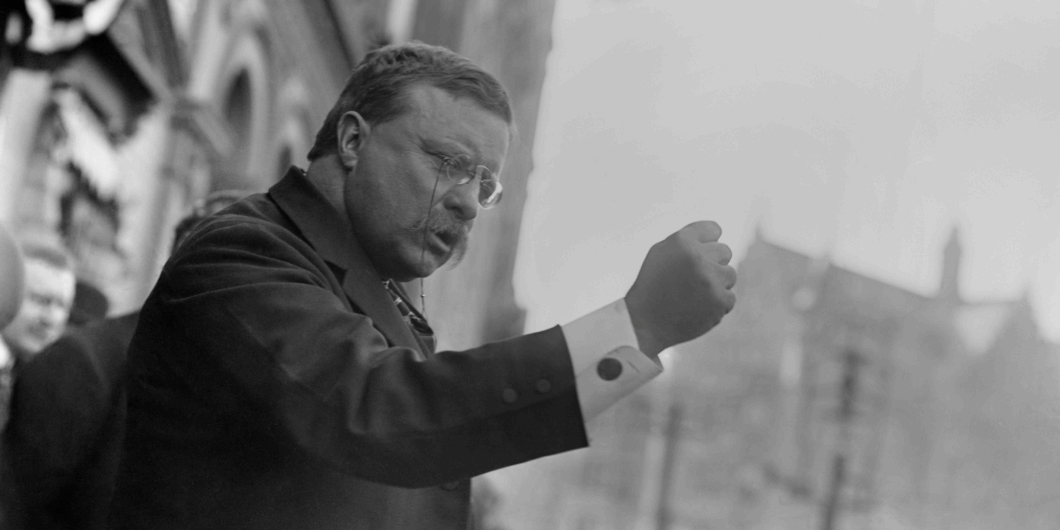
Theodore Roosevelt came of age and rose to prominence in the late 1800s and, arguably, launched what Time magazine publisher H. R. Luce would later call the “American Century.” As the Gilded Age faded, Roosevelt shaped America’s entry into world affairs and created the impetus for a robust America First foreign policy and hegemony in the Western Hemisphere. By sheer force of personality, he enlarged the stature of the presidency and the executive’s role in shaping public policy. No stranger to controversy and conflict, Roosevelt spoiled for a fight and delighted in lacerating his enemies with calculated comments and ridicule. In short, Roosevelt would be equally at home in both the early twentieth and twenty-first century American politics.
Historian David S. Brown’s newest work, In the Arena: Theodore Roosevelt in War, Peace and Revolution, is a fresh and timely biography that describes the “hard and dangerous endeavor” of the life and times of the 26th President. By turns husband, father, cowboy, hunter, soldier, explorer, conservationist, legislator, administrator, reformer, statesman, peacemaker, and politician, the book recounts how Roosevelt created a legacy that endures in the twenty-first century and in the modern office of the American presidency.
Politician
In the Arena traces Roosevelt’s family history, the foundations of his multi-million (today billion) dollar fortune, his liberal education, travel abroad (including two tours of Europe before he was 15 years old), Harvard pedigree, and Brahmin social inheritance. These were among the conventions that marked a man in America’s old money upper class at the turn-of-the-century. There was, however, nothing conventional about Roosevelt, and especially his meteoric rise in politics. While Brown acknowledges “Roosevelt’s auspicious timing—‘Teddy’s luck!’ as Henry Adams had it,” the author also makes it clear that Roosevelt possessed an uncommon political acumen. His first foray into politics only came after he had made a studied assessment of the Republican Association in New York City and allied himself with machine politicians “eager to nominate a fresh face.”
Elected to the New York Assembly in 1882, the twenty-three-year-old legislator sprang into the state capital ready “to play up to the papers,” and “introduce a slew of bills … that had absolutely no chance of being taken up by the Legislature,” even as he “happily posed as a crusader.” This was the hugely public persona, Brown argues, that Roosevelt would hew to during his entire career in politics.
Roosevelt’s time in the assembly also occasioned the first of many of his savvy political alliances, in this case with New York Governor (and later president) Grover Cleveland, a Democrat. It would not be the last time in Roosevelt’s political career, Brown notes, that he would seek out allies from among various political factions, but, for the most part, he understood the importance of being a party stalwart.
The book reveals Roosevelt as a man of restless, powerful ambitions with real political skills. Brown shows him as a capable politician with “an uncanny ability to read the times,” a progressive who extracted the social changes people wanted from the grudging powerbrokers of the age. Roosevelt proved to be a “shrewd political fighter, understanding the all-important art of picking his battles.” The author also describes how Roosevelt played machine politics to gain office by appointment and serve as head of the nation’s Civil Service Commission (1889), police commissioner of New York City (1895), and undersecretary of the Navy (1897). Party politics would propel him into elected office as governor of New York (1898) and as vice president of the United States (1901). A bullet—not the ballot—would make him president when McKinley was assassinated before Roosevelt was elected to the office in his own right in 1904.
Party Leader, Progressive
Roosevelt’s accession to the presidency made him the de facto leader of the GOP. Brown, in several insightful passages, shows Roosevelt exerting influence in the party years before he became president. He paints a portrait of Roosevelt as a reliable if sometimes unwilling party loyalist, as “the rise of mass democracy made partisan loyalties the sine qua non for political advancement.” Roosevelt, for example, abandoned fellow independent Republicans—Mugwumps—who bolted ranks to support Democrat Grover Cleveland in the 1884 presidential contest with GOP candidate James G. Blaine. When it came time for the machine to put up a mayoral candidate in the 1886 New York City election, Roosevelt accepted the nomination in a contest he knew he would not win. He became the party standard-bearer, a willing sacrificial lamb.
The egotist in him craved praise and recognition and vengefully despised detractors.
Brown also argues that Roosevelt—the loyalist who maneuvered from within—also became a change agent in tune with the shifting American scene. Equally at home with silk-stocking elites, artists, poets, soldiers, ranchers, and Dakota cowboys, Roosevelt grew to know and understand Americans from all walks of life. Alive to the growing concerns of a rising middle-class constituency, he looked askance at both socialists and at what he branded as the “vulgar” capitalists seeking profits at any cost.
The author recounts Roosevelt’s political career as one of a maturing politician who came to grips with the social and economic turmoil in late nineteenth century America. In the face of what he described as the “pernicious impact of monopolization upon consumers and workers,” Roosevelt embraced, by degrees, a regulatory state model of government. Brown argues that Roosevelt came to embody the essence of the Progressive Era in his efforts to offer all Americans a “square deal.”
The first among many in the GOP, he represented a break with laissez-faire traditionalists who favored policies to promote unbridled industrialization and the interests of capital. An unrelenting opponent of the stultifying results of patronage and the spoils system, he eventually railed against machine politics. Roosevelt proved to be the most vocal and enduring of the party’s progressives, on the side of one faction that created a permanent fissure in the party:
This dissonance between factions would remain a feature of the party’s institutional DNA … it anticipated the moderate Nelson Rockefeller (northeastern)—versus—Barry Goldwater (Sunbelt) struggle in 1964, and the still-longer contest for ideological supremacy between liberal and conservative Republicans in the twenty-first century.
Policymaker
The author argues the case for Roosevelt as the right man at the right time, as the turn-of-the-century United States—newly possessed of an overseas empire and on the cusp of the industrial age—needed both an internationalist and a nationalist at the helm. Brown makes the astute assessment that Roosevelt assumed “the reins of government at the precise moment when his style of leadership, cautiously progressive and globally focused, met the culture half-way; TR spoke on behalf of a rising generation.”
He was the first American president to take on the challenge of creating practices and policies to reflect the nation’s new status as a rising great power. In the Arena describes how Roosevelt disingenuously supported a breakaway Colombian province to create a newly independent Panamanian nation amenable to the construction of an interocean canal. A long-time “big navy” advocate, as commander-in-chief, he defied Congress to countermand his orders and sent the US Navy’s Great White Fleet on a globe-girdling cruise. It was, by his design, a demonstration of power on a voyage “to speak softly and carry a big stick” with visits to re-arming European powers and a restive Japan. Wary of foreign interference in the Americas, he issued the Roosevelt Corollary to the Monroe Doctrine and simply assumed the power to police the internal affairs of Caribbean countries and keep peace in the region. A keen observer of foreign affairs, Roosevelt brokered an end to the Russo-Japanese War (1904-5) and, for those efforts, was awarded the Nobel Peace Prize. In the author’s assessment, Roosevelt’s foreign policy was “by turns belligerent, pragmatic, and generally effective.”
On the domestic front, the author describes how Roosevelt’s public policymaking ended a crippling national coal mining strike and laid the groundwork for organized labor and collective bargaining. Boosted by the president, Congress pushed through legislation to regulate the railroads and passed the landmark Pure Food and Drug Act. That legislation solidified the authority of the central government—and its readiness—to regulate business and industry in the public interest. These and other measures to improve the lot of average Americans were, Brown argues, what Roosevelt saw as practical democratic alternatives to radicalism and to the collectivism demanded by a growing number of socialists. “Roosevelt,” in Brown’s assessment, “understood, as few of his predecessors had, the potential of the presidency to affect public policy,” and thereby permanently altered the balance of power in Washington. The trend of power shifting to the Executive has, the author notes, continued to this day.
In the Arena is not a one-sided, adulatory record of Roosevelt’s remarkable career. The author is an even-handed biographer and cites less than appealing incidents and aspects of Roosevelt’s life and character. The egotist in him craved praise and recognition and vengefully despised detractors. The author recounts, for example, the self-centered Roosevelt’s unseemly lobbying to be awarded the Medal of Honor for his charge up San Juan Hill in Cuba. He openly loathed Woodrow Wilson but still appealed to that president for a field officer’s commission during WWI. Peckish with critics, he baited his opponents with name-calling—the very well-read Roosevelt added “muckraker,” “weasel words,” “lunatic fringe,” “pussyfooters,” and “loose cannon” to the American lexicon. Brown’s balanced and nuanced assessment of Roosevelt makes In the Arena a worthwhile addition to other biographies, including Edmund Morris’ magisterial trilogy (The Rise of Theodore Roosevelt, Theodore Rex, Colonel Roosevelt) and David McCullough’s Roosevelt family biography, Mornings on Horseback.
Brown’s writing is well-paced, free from windy passages, and often marked by apt phrasing. For example, he describes how “the Roosevelt White House, filled with six children, trembled with energy.” However, the author is sometimes given to stilted writing. The Roosevelt children, to cite one instance, are “his begats,” with whom he “cultivated … a gladsome routine.” This, and the absence of a standard bibliography, is a small criticism. The book is a sturdy biography rooted in period history, based both on the author’s carefully noted and attributed research and his extensive knowledge of the times.
In the Arena offers readers a compelling account of the “strenuous life” of Theodore Roosevelt and a book remarkably relevant in recounting a historical precedent to the current American political scene. This, then, is the biography of a man in the arena whom Roosevelt himself described as one “who spends himself in a worthy cause; who at the best knows in the end the triumph of high achievement, and who at the worst, if he fails, at least fails while daring greatly.”
[ad_2]
Source link
