
Voters Do Not Want the U.S. to Acquire Greenland
After invading Venezuela to oust its leader and begin “running” the country, the Trump administration set its sights on Greenland. On January 21, after threatening to use military force to annex the island, President Donald Trump announced a “framework of a future deal” over Greenland. Trump continues to claim that the U.S. will have “total access” to Greenland, while European officials stress that Greenland will remain under Danish control.
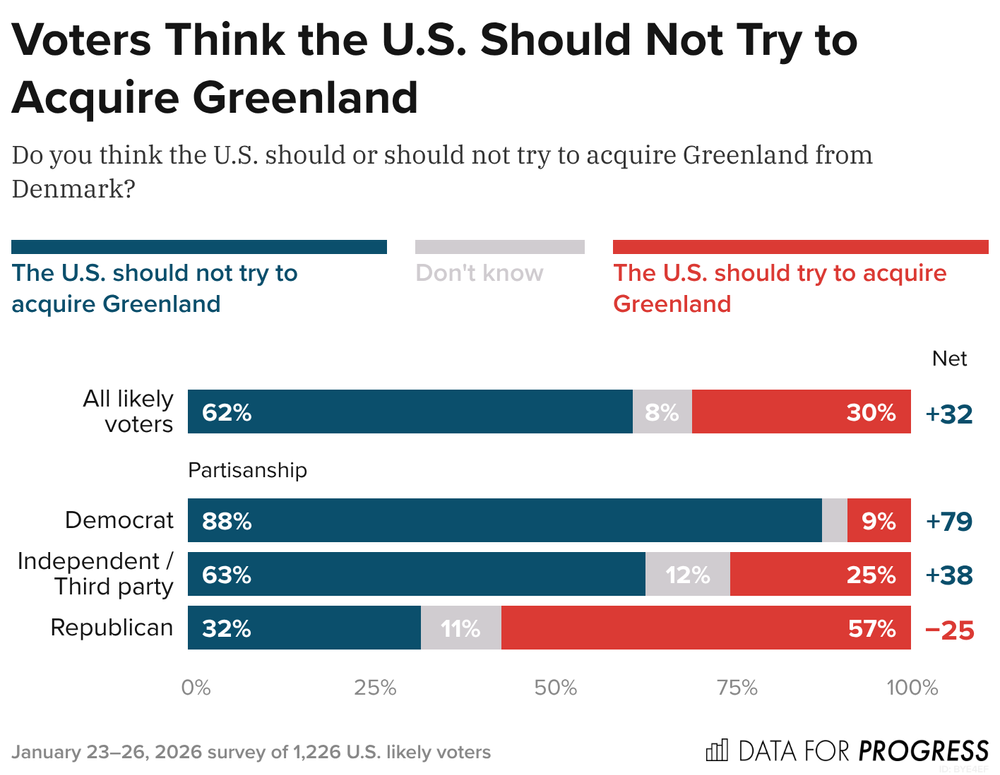
In a new survey, Data for Progress finds that a strong majority of voters (62%) think the U.S. should not try to acquire Greenland, while 30% think it should. Majorities of Democrats (88%) and Independents (63%), as well as about 1 in 3 Republicans, agree the U.S. should not try to acquire the island.
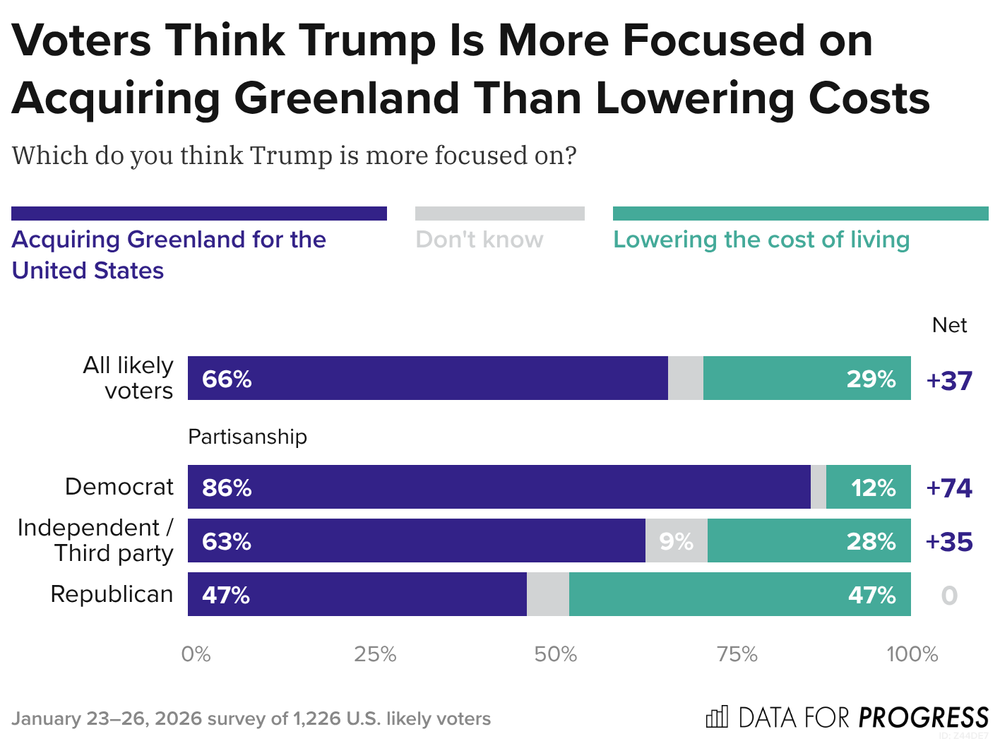
A strong majority of voters believe that Trump is more focused on acquiring Greenland (66%) than lowering the cost of living (29%), their top priority.
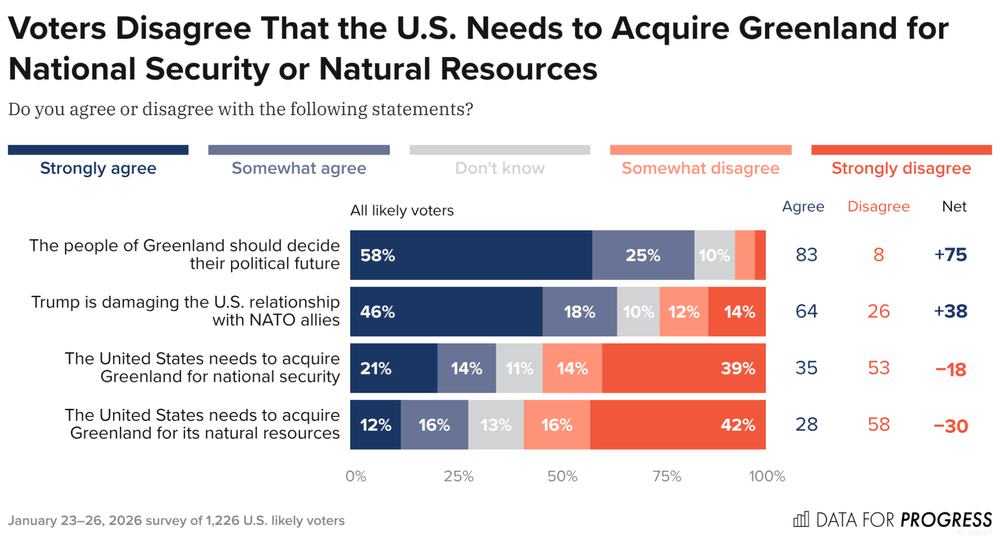
Strong majorities of voters agree that the people of Greenland should decide their political future (83%) and that Trump is damaging the U.S. relationship with NATO allies (64%). Majorities disagree that the U.S. needs to acquire Greenland for natural resources (58%) or for national security (53%).
Together, these findings indicate that voters strongly believe that the U.S. should not try to acquire Greenland, that doing so is not necessary for U.S. national security or natural resources, and that Trump is more focused on acquiring Greenland than addressing their top priority: the cost of living.
Cover photo attributable to Jensbn.

Survey Methodology
From January 23 to 26, 2026, Data for Progress conducted a survey of 1,226 U.S. likely voters nationally using web panel respondents. The sample was weighted to be representative of likely voters by age, gender, education, race, geography, and recalled presidential vote. The survey was conducted in English. The margin of error associated with the sample size is ±3 percentage points. Results for subgroups of the sample are subject to increased margins of error. Partisanship reflected in tabulations is based on self-identified party affiliation, not partisan registration. For more information please visit dataforprogress.org/our-methodology
[ad_2]
Source link
