
Voters Increasingly Think Artificial Intelligence Will Hurt the Economy
There is little consensus about the impact of artificial intelligence on the American job market, with some analyses finding minimal impact and others predicting catastrophic job loss.
A previous Data for Progress survey examined how voters’ general perceptions of AI vary across demographic and partisan lines. In a new survey, Data for Progress asked voters more specifically about how they think AI will impact the economy — including its impact on the employment rate, voters’ ability to keep their own jobs, and the wealth of “everyday people.”
The survey finds that voters think AI will have mostly negative implications for the U.S. economy.
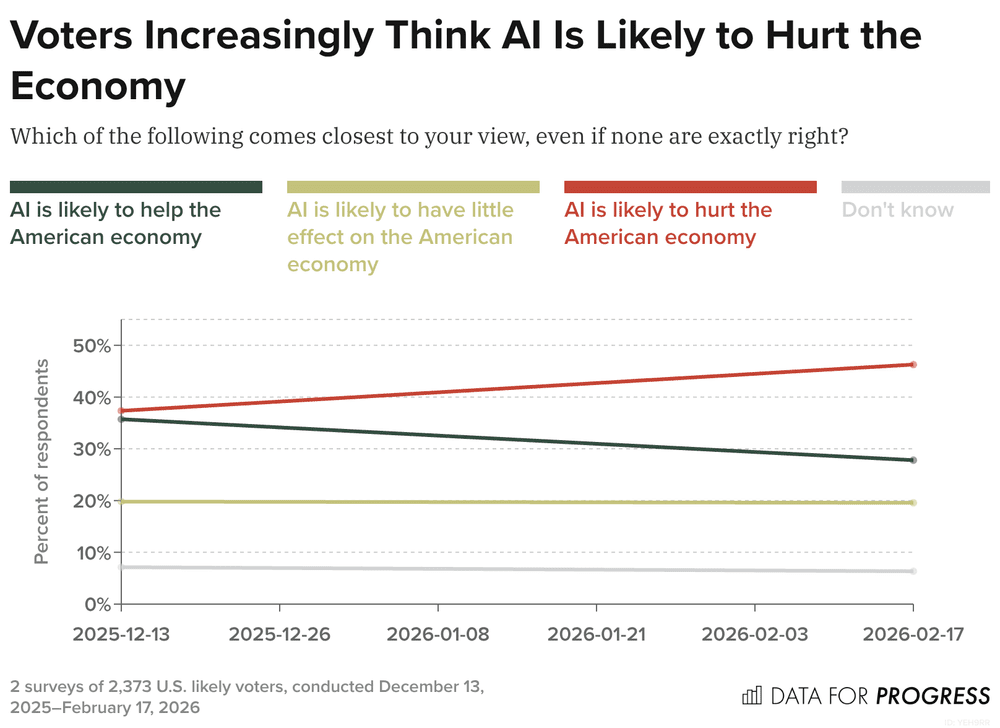
A plurality of voters (46%) think that AI is likely to hurt the American economy, while only 28% think it is likely to help. This is a notable change from December 2025, when voters were about evenly split between thinking AI would hurt (37%) or help (36%) the economy. This shift is particularly pronounced among Democrats: The percentage of Democrats believing AI will hurt the economy has risen from 34% in December 2025 to 53% in the new survey.
Voters who are female (53%), Democrats (53%), at least 45 years old (51%), and not college educated (51%) believe AI will hurt the economy more than their male (39%), Republican (39%), under 45 (36%), and college-educated (38%) counterparts.
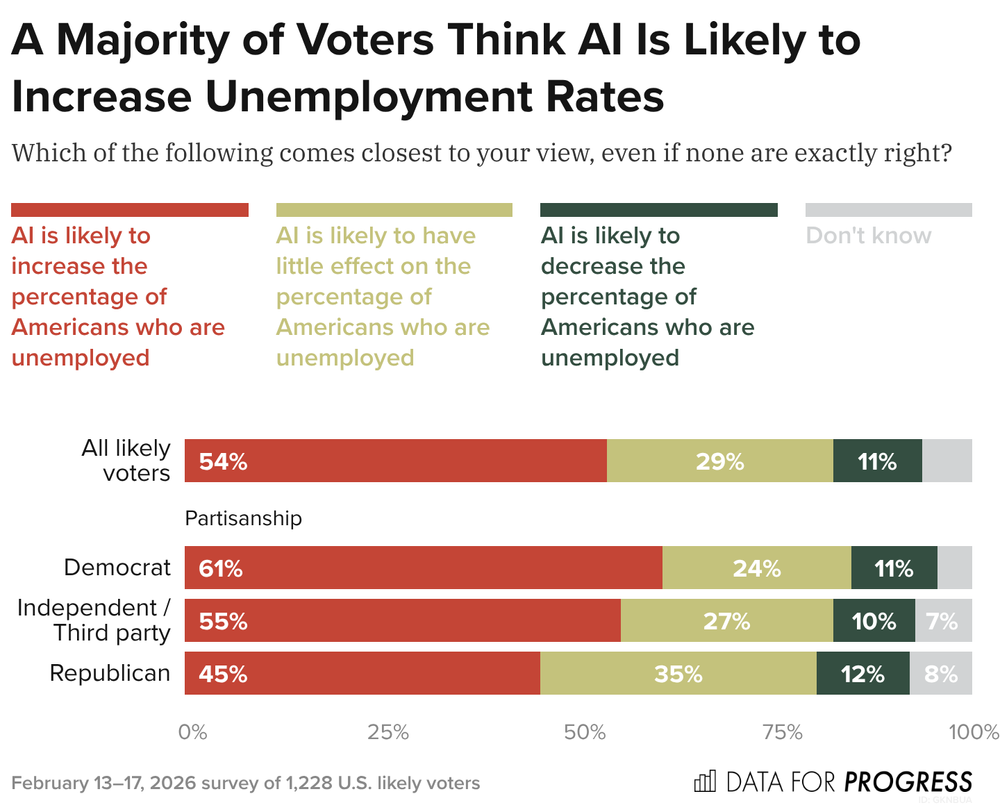
A majority of voters (54%) think that AI is likely to increase the percentage of Americans who are unemployed, while only 11% think AI will improve employment rates.
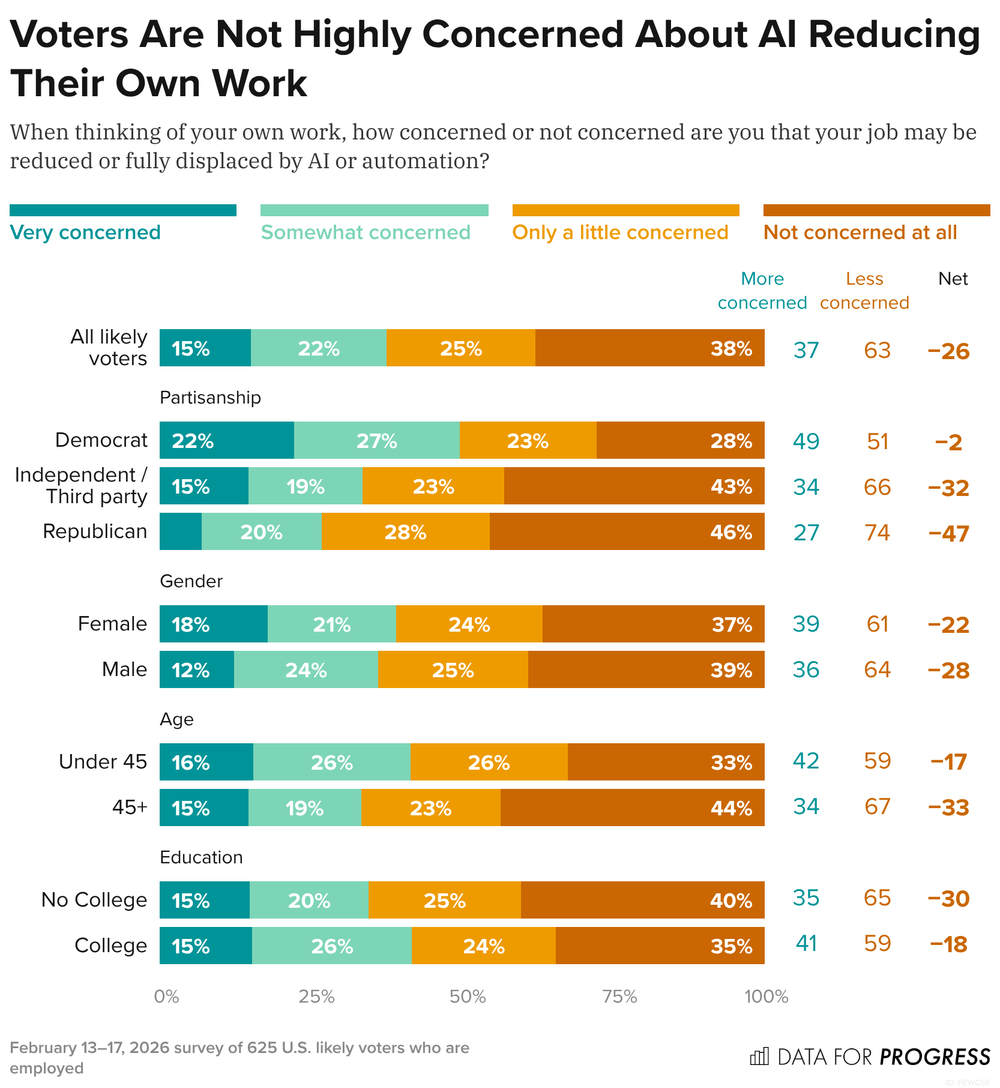
Next, survey respondents who are currently employed were asked whether they are concerned about their own job being “reduced or fully displaced by AI or automation.”
While 37% of employed voters are “very concerned” or “somewhat concerned” about AI reducing or displacing their job, most employed voters (63%) are either “only a little concerned” or “not concerned at all.”
There is a notable partisan gap in voters’ concerns over AI impacting their own jobs, with 49% of Democrats concerned, compared with just 34% of Independents and 27% of Republicans. The percentage of Democrats who are concerned about AI impacting their own work has risen from 39% in August 2025 to 49% in the new survey, while the percentages of Independents and Republicans who are concerned have declined slightly.
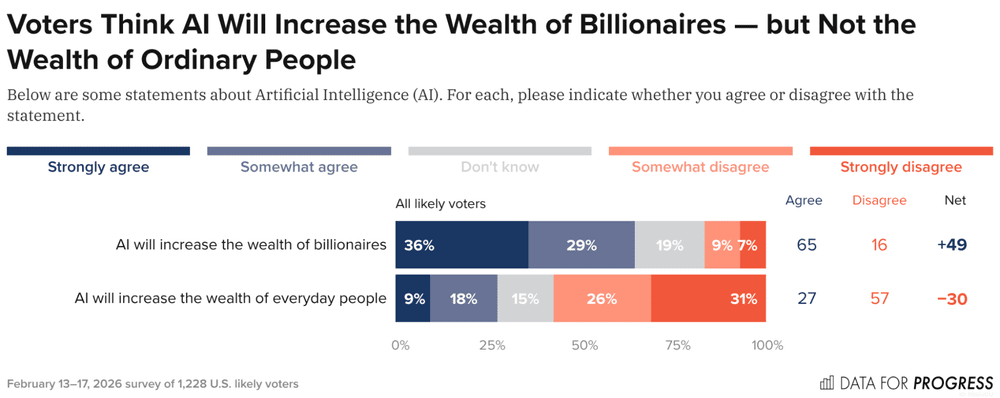
When asked whether they agree or disagree that “AI will increase the wealth of billionaires,” a majority of voters (65%) say they agree. However, a strong majority of voters (57%) disagree that “AI will increase the wealth of everyday people.”
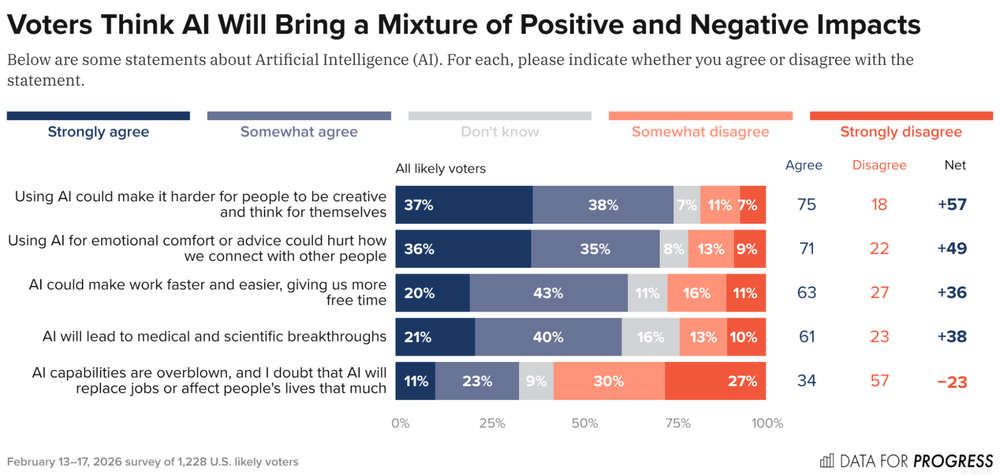
Voters believe AI will have a mixture of both positive and negative impacts on society.
For example, a strong majority of voters agree that “using AI could make it harder for people to be creative and think for themselves” (75%) and that “using AI for emotional comfort or advice could hurt how we connect with other people” (71%). However, at least 3 in 5 voters also agree that AI “could make work faster and easier, giving us more free time” (63%) and that it “will lead to medical and scientific breakthroughs” (61%).
Notably, a majority of voters (57%) disagree that “AI capabilities are overblown, and I doubt that AI will replace jobs or affect people’s lives that much.”
Broadly, these findings indicate that voters increasingly believe that AI will hurt the economy. While voters are not highly concerned about AI impacting their own jobs, a majority think that AI is likely to increase the U.S. unemployment rate. A majority also believe that AI will widen inequality, increasing the wealth of billionaires but not increasing wealth for “everyday people.”
Survey Methodology
From February 13 to 17, 2026, Data for Progress conducted a survey of 1,228 U.S. likely voters nationally using web panel respondents. The sample was weighted to be representative of likely voters by age, gender, education, race, geography, and recalled presidential vote. The survey was conducted in English. The margin of error associated with the sample size is ±3 percentage points. Results for subgroups of the sample are subject to increased margins of error. Partisanship reflected in tabulations is based on self-identified party affiliation, not partisan registration. For more information please visit dataforprogress.org/our-methodology
Source link www.dataforprogress.org
