
Voters Prefer Pro-LGBTQ+ Candidates and Policies Aimed at Supporting Youth
June is LGBTQ+ Pride Month, a celebration of the LGBTQ+ community’s history, culture, and contributions. And yet, President Donald Trump has not formally recognized the occasion as he did in his first term. In fact, several Republican-led states have designated June “Nuclear Family Month.” Public opinion has shifted right on LGBTQ+ issues over the last several years, largely concentrated among self-identified Republicans. In the 2024 election cycle, Trump and Republican candidates spent at least $215 million on television ads attacking Democrats on transgender issues.
Despite this cultural shift, new polling from Data for Progress finds that likely voters prefer candidates who are vocally supportive of LGBTQ+ rights and show strong support for several pro-LGBTQ+ policies.
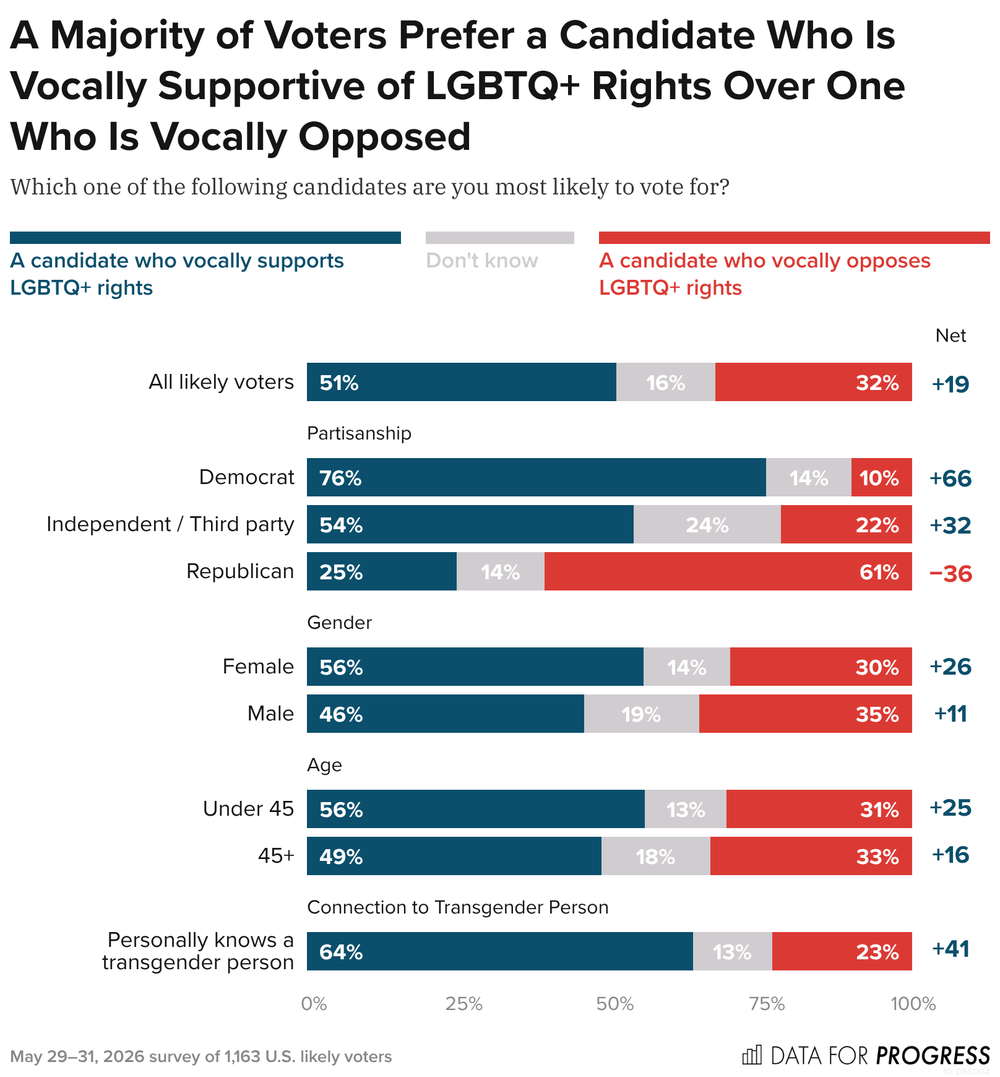
While voters continue to rank LGBTQ+ issues low in terms of which issue they consider most when deciding which candidate to vote for, that doesn’t mean most voters don’t care about LGBTQ+ issues. By a +19-point margin, voters say they would prefer a candidate who vocally supports LGBTQ+ rights (51%) over a candidate who vocally opposes LGBTQ+ rights (32%). This includes majorities of Democrats (76%) and Independents (54%), as well as 1 in 4 Republicans (25%).
Voters who are women or under 45 report higher support for a candidate who vocally supports LGBTQ+ rights than their counterparts who are male or 45 and older, though pluralities in those subgroups also say they would prefer the pro-LGBTQ+ candidate. Consistent with Data for Progress’ previous polling, there is a clear disparity between people who personally know a transgender person and those who do not.
In recent years, two issues related to transgender youth have dominated anti-LGBTQ+ legislative action: bans on sports participation and medical care. While polls from Pew Research Center, Gallup, and The New York Times/Ipsos have shown high levels of support for these bans among U.S. adults, Data for Progress’ surveys have demonstrated that Americans are more closely divided when specifically asked to choose who should have jurisdiction over these decisions.
While sports participation and youth medical care remain divisive issues, there are many other issues related to the LGBTQ+ community that command majority support — and plurality support among Republicans — even if they receive less attention.
Policies aimed at protecting LGBTQ+ youth from bullying and supporting their mental health are particularly popular. More than 60% of voters, including majorities of Independents and pluralities of Republicans, support “encouraging school districts to implement anti-bullying and harassment policies that protect LGBTQ+ students” (63%), “investing in mental health services for LGBTQ+ students” (62%), and “restoring federal funding for the 988 Suicide and Crisis Lifeline’s specialized crisis services for LGBTQ+ youth” (61%).
A majority of voters also support “granting Veterans Affairs benefits to former members of the U.S. military who were discharged for being LGBTQ+” (58%) and “prohibiting discrimination against prospective LGBTQ+ parents in adoption and foster care” (57%). Independents support both of these measures by more than +30-point margins.
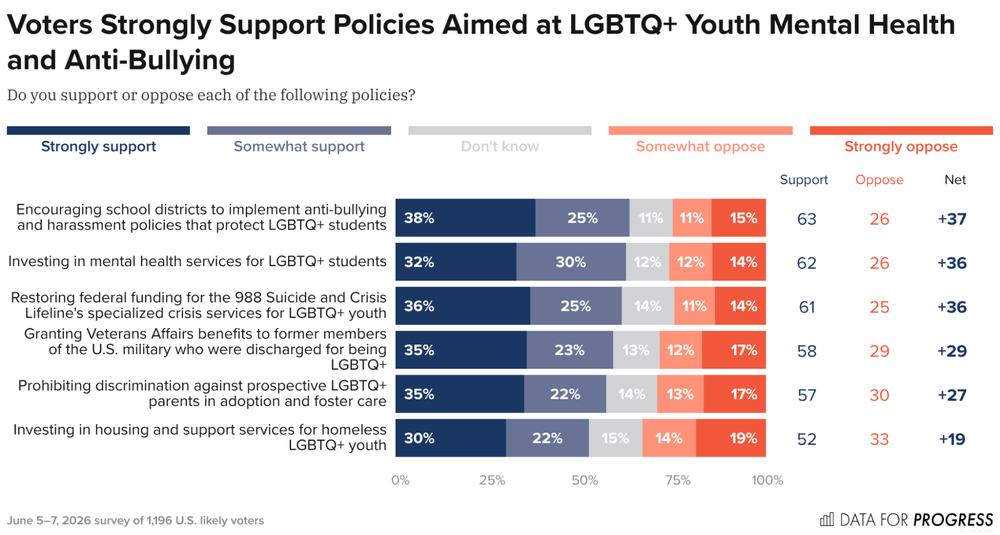
These findings reveal that voters largely prefer candidates who are vocally supportive of LGBTQ+ rights over those who are vocally opposed, and strongly support policies aimed at protecting LGBTQ+ students and youth mental health.
Source link www.dataforprogress.org
